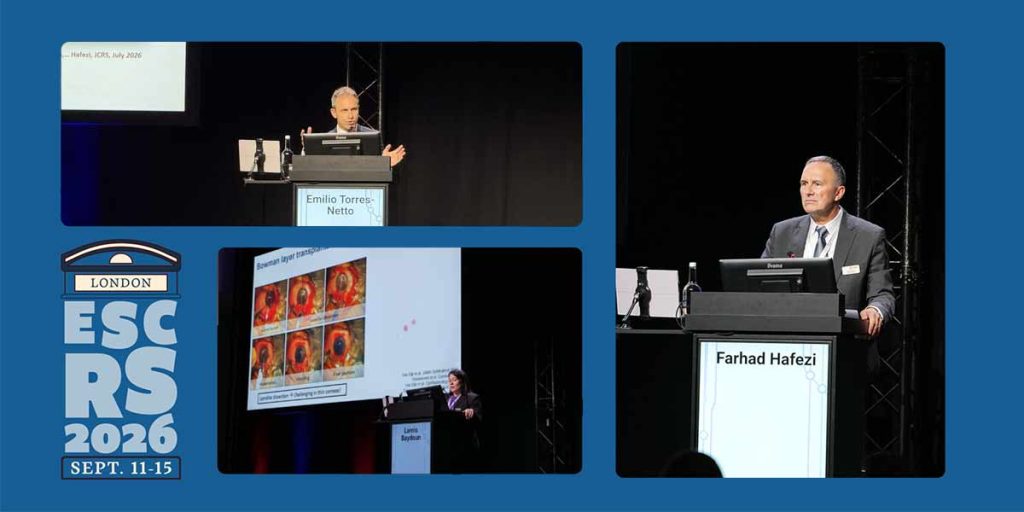
CAKE Magazine ESCRS 2026 coverage has turned to a question most keratoconus patients never hear asked out loud. Can the full-thickness corneal transplant be retired altogether? Writing for the Media MICE title, Michaela Perez reported on a London session. Five surgeons made the case that it can, and they set a date of 2040. Three of the five speak for the ELZA Institute.
Key takeaways
- CAKE Magazine reported on a session at the 44th ESCRS Congress in London, held 11 to 15 September 2026.
- Five surgeons presented techniques intended to make full-thickness corneal grafts unnecessary in keratoconus.
- Only one of them, ELZA-PACE, uses no donor tissue at all.
- Prof. Farhad Hafezi, Dr. Emilio A. Torres-Netto and Dr. Lamis Baydoun presented three of the five.
What the CAKE Magazine ESCRS 2026 report covered
Keratoconus thins and steepens the cornea, the clear window at the front of the eye. As the cornea bulges into a cone, vision distorts and glasses stop helping. Corneal cross-linking (CXL) – riboflavin drops plus ultraviolet light, which stiffens the cornea – halts that progression in most patients. For some, however, cross-linking arrives too late. Once the cornea is scarred or severely irregular, surgeons have traditionally turned to penetrating keratoplasty. That means a graft through the full thickness of the cornea.
The operation restores clarity, but the trade-offs are substantial. The graft never regains full strength, rejection remains possible for life, and the resulting astigmatism is hard to predict. Donor tissue is scarce as well. The five techniques in the report all attack the same problem from different directions, by doing less and doing it more precisely.
The only donor-free option in the report
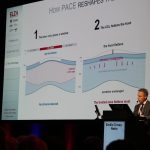
Prof. Farhad Hafezi presented ELZA-PACE, a customised epi-on cross-linking protocol. It pairs cross-linking with phototherapeutic keratectomy (PTK), a surface laser treatment. Rather than replacing tissue, it reshapes what is already there. Hafezi reported up to 20 D of corneal regularisation, with no donor tissue and no removal of stromal tissue. At one year, 40% of eyes had dropped at least one disease stage. There was no progression and no loss of vision. Despite delivering three times the standard energy dose, he reported no clinically significant haze. The protocol has been used in patients as young as 13. What limits wider use is regulatory rather than clinical. The epi-on riboflavin formulation is still awaiting its CE mark.
Four techniques that use donor tissue sparingly
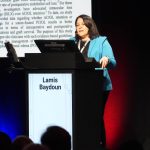
Dr. Lamis Baydoun described Bowman layer transplantation. The technique slides a single thin donor layer into the cornea instead of replacing the whole of it. Around 90% of cases stopped progressing, and both higher-order and spherical aberrations fell measurably. The technique does not improve visual acuity, however, and harvesting the layer is technically demanding. On the other hand, one donor cornea can supply grafts for three patients.
Dr. Shady Awwad presented an asymmetric, femtosecond-laser-cut version of CAIRS – corneal allogenic intrastromal ring segments. These are crescents of donor cornea, placed inside the patient’s own cornea to flatten and regularise it. Awwad reported around 5 D of flattening at the steepest point, plus a meaningful reduction in coma. Corrected vision came out slightly better than with the plastic PMMA segments they replace. Complications included three tunnel-roof melts and one or two rejection episodes. He also named a gap the field has yet to close. There is no shared registry, and nomogram evidence remains limited.
Dr. Emilio A. Torres-Netto reported on ECO-CAIRS, in which the donor segments are cross-linked before implantation. Treating the tissue at 30 J/cm² makes the segments firmer, drier and easier to thread into the corneal tunnel. It may also lower rejection risk, although that is not yet established. In one case complicated by scar tissue from earlier plastic rings, vision improved from 0.4 to 0.8 decimal acuity. That is roughly 20/50 to 20/25.
Prof. Emilio Pedrotti closed with SLAK, or stromal lenticule additional keratoplasty. It fills the thinned, bulging area with a lens-shaped piece of donor tissue. The back surface of the cornea regularises well, while the front surface responds less readily. Combined with customised PTK, patients gained three lines of best-corrected spectacle vision. Crucially, SLAK does not rule out a full graft later if one becomes necessary.
Where the CAKE Magazine ESCRS 2026 report left the question open
The session did not end in consensus, and the report says so. Four of the five techniques still depend on donor tissue, only in smaller and smarter doses. Progression risk has not gone away. Surgical nomograms are thin, and follow-up is short next to the decades of data behind penetrating keratoplasty. Whether 2040 proves realistic is therefore not a question about the ideas. It is a question about the evidence behind them.
ELZA-PACE and ECO-CAIRS are both performed at the ELZA Institute, alongside conventional cross-linking for keratoconus and the wider range of corneal surgery. ELZA’s own account of the session is published here.
References
- Perez M. Can full-thickness corneal transplants for keratoconus disappear by 2040? Five techniques make their case at ESCRS 2026. CAKE Magazine, Media MICE, 13 September 2026. Read the full report
- European Society of Cataract and Refractive Surgeons. 44th Congress of the ESCRS