

A swelling above the outer corner of the eye can be several things: inflammation, a benign growth or, less often, a cancer. Telling them apart early decides how a patient is treated. That problem was the subject of the keynote lecture given by Dr. Dion Paridaens, MD, PhD, ELZA’s Consultant Oculoplastic and Orbital Surgeon, at COSC 2026, the 15th Conjoint Ophthalmology Scientific Conference in Kuala Lumpur.
Two lectures at COSC 2026
The conference ran from 18 to 20 September. Dr. Paridaens spoke twice on 19 September. His keynote lecture was titled “Pitfalls in the Diagnosis of Lacrimal Tumours”. An invited lecture followed: “Not Every Lump is a Tumour: Decoding Orbital Inflammation”.
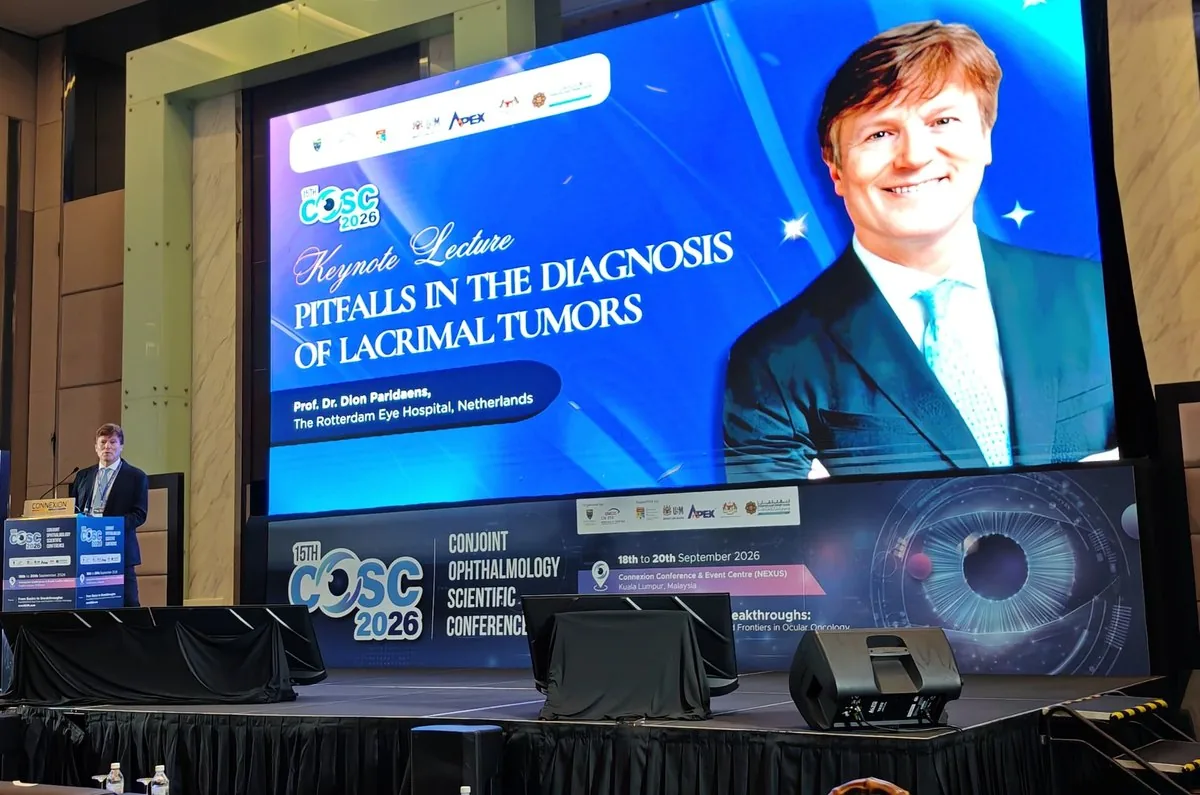
Why lacrimal gland tumours are easy to misread
The lacrimal gland produces the watery part of the tears. It sits in the upper outer part of the orbit, the bony socket that holds the eye. Many enlargements of the gland are caused by inflammation or lymphoid disease rather than by a tumour of the gland itself, and benign and malignant lesions can look alike at first.
The distinction matters for treatment. A pleomorphic adenoma, the most common benign tumour of the gland, is usually removed whole, because a breached capsule can let it recur. A malignant tumour such as adenoid cystic carcinoma needs a different, often multidisciplinary, plan. The history of the swelling, imaging and, where appropriate, a biopsy help orbital surgeons choose the right path.
When a lump is not a tumour
The second lecture turned to orbital inflammation. Inflammation in the orbit can mimic a tumour on examination and on scans, yet it is usually managed medically rather than by removing tissue. Orbital inflammatory disease has been a focus of Dr. Paridaens’ research for many years.
Former fellows on the faculty
The COSC 2026 faculty included four oculoplastic surgeons who trained as fellows under Dr. Paridaens at the Rotterdam Eye Hospital: Fazliana Ismail, the conference’s Scientific Chairperson, Hanida Hanafi, Vanessa Neoh and Caroline Binson. Dr. Paridaens has directed the oculoplastic fellowship in Rotterdam since 2002.
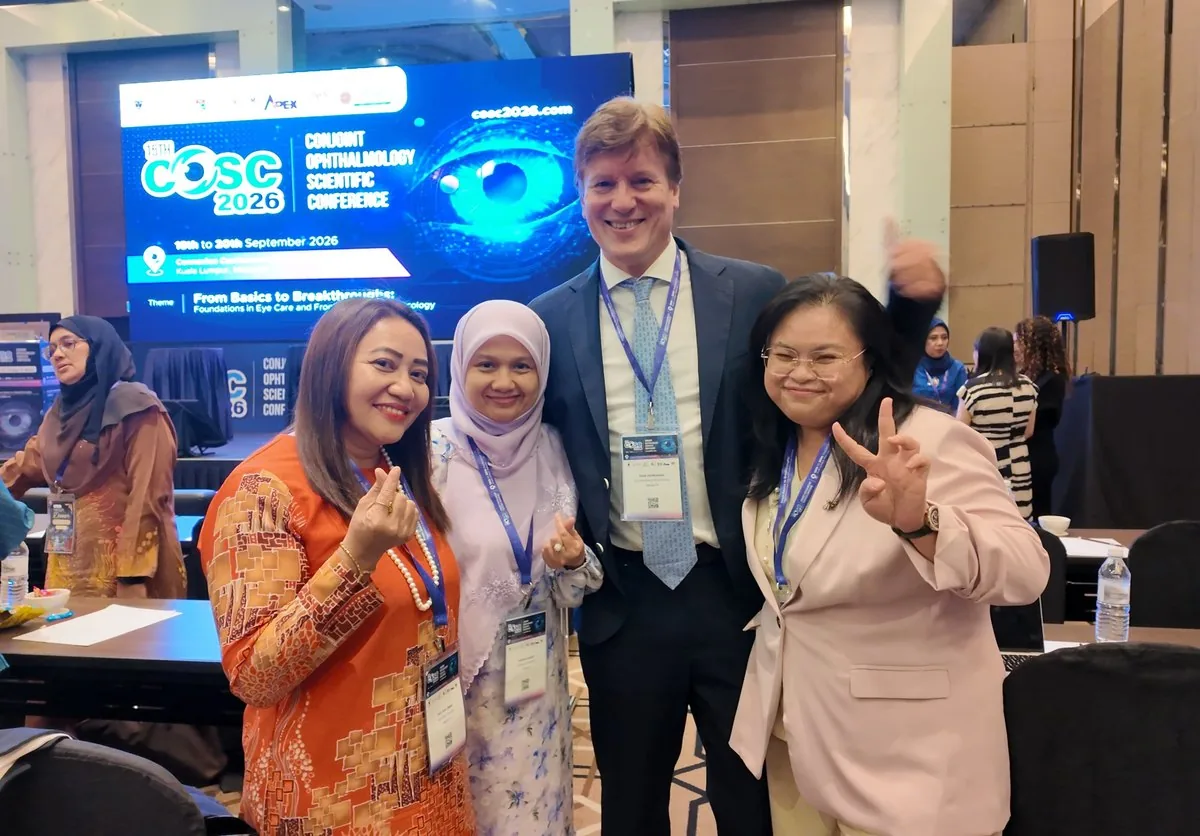
He also met the ocular oncologist Arun Singh for the first time. The two had never crossed paths, although both trained under the late John Hungerford at Moorfields Eye Hospital in London.
Oculoplastic and orbital surgery at ELZA
He is Chair of the Medical Board of the Rotterdam Eye Hospital, heads the Orbital Service at Erasmus MC and is a Past-President of the European Society of Ophthalmic Plastic and Reconstructive Surgery (ESOPRS). At the ELZA Institute he assesses and treats patients with eyelid, lacrimal and orbital conditions. Earlier this year he presented a complex orbital tumour case at the International Orbital Society Meeting 2026.
