
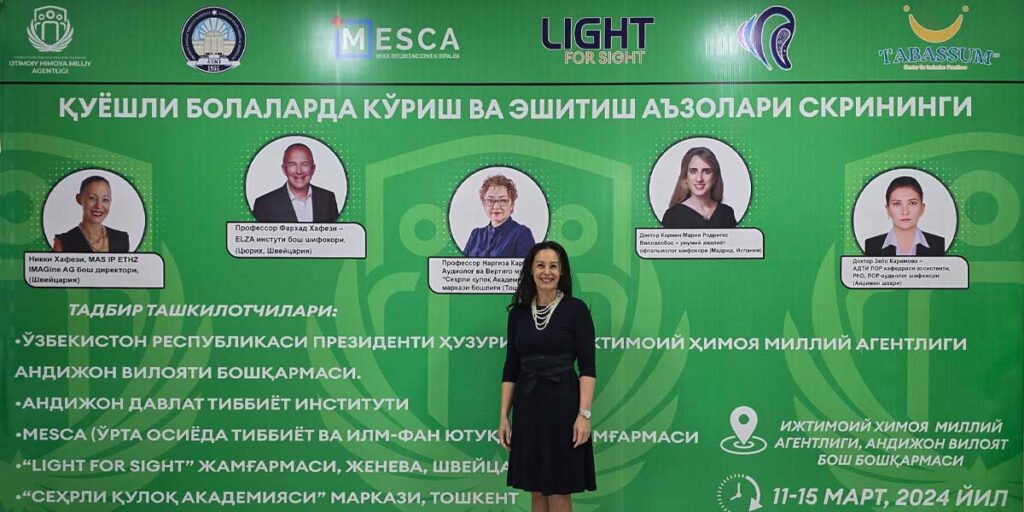
On March 13, the ELZA Institute, led by CEO Nikki Hafezi, initiated a keratoconus screening event in Andijan, Uzbekistan. This effort marks a significant step in addressing the needs for early detection and management of keratoconus, which left untreated, can lead to significant visual impairment and ultimately blindness.
The screening event in Andijan had a second purpose in addition to screening, which was to train local healthcare professionals and support staff in how to perform keratoconus screening and to establish best-practice models in the region. Of particular note was the focus of the event on screening people with Down syndrome, where the prevalence and risk of keratoconus are considerably higher than the rest of the population.
The sustainability of this project lies in its collaborative nature and the transfer of knowledge and expertise to local healthcare providers. This initiative aims to empower the local medical community, enhancing their ability to diagnose and treat keratoconus independently.
A crucial element of this program is the implementation of the Keratoconus Mapping (KMAP) protocol which is a programme run to determine the true prevalence of keratoconus in several regions of the world, including Uzbekistan. This screening event was supported by the Andijan State Medical Institute (ASMI) and the Agency of Social Support. The partnership between the ELZA Institute, the Light for Sight foundation and ASMI via a Memorandum of Understanding underscores a shared commitment to improving training and research opportunities in the field.
In a presentation given during the screening event, Nikki Hafezi spoke about the benefits of promoting international relations and collaborative research on keratoconus, and how this project is helping to foster a deeper understanding of keratoconus and its management, with lessons that can be applied worldwide. Our CEO emphasized the importance of early screening, detection, and treatment to prevent visual impairment that can impact learning and employment – not just in children with Down syndrome, but for all children.
