
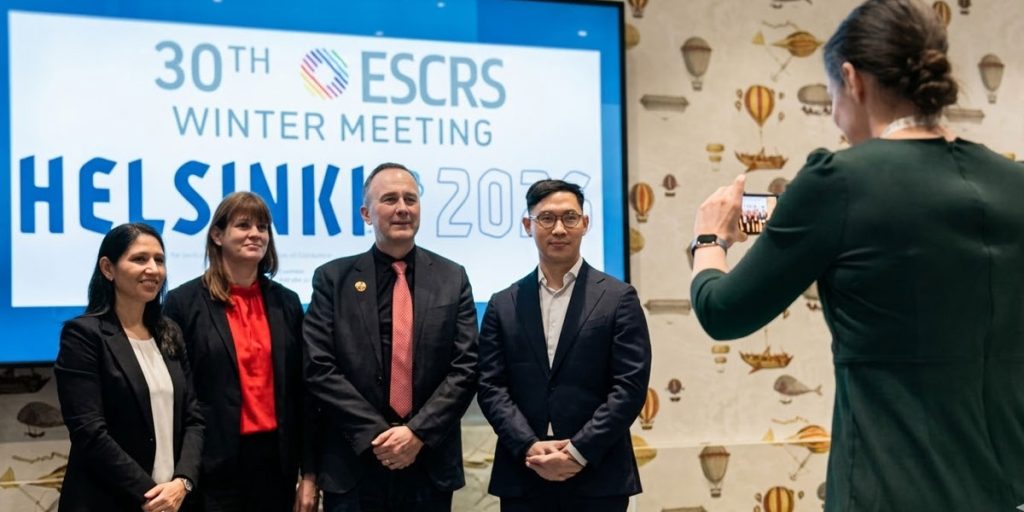
ELZA at ESCRS Helsinki 2026
Can a professional society effectively bridge the gap between disruptive surgical innovation and the necessity for global clinical standardization? This question underpinned much of the discourse at the 30th ESCRS Winter Meeting in Helsinki. For the ELZA Institute, the meeting served as a vital forum for both institutional governance and the introduction of refined surgical techniques. Professor Farhad Hafezi, MD, PhD, FARVO, the Chief Medical Officer of the ELZA Institute, played a central role in these proceedings, balancing his clinical research with his responsibilities as the Head of the Scientific Committee of the ESCRS.
The Drive Toward Global Standardization
TThe meeting’s agenda reflected a deepening commitment to establishing a unified language for corneal disease. Within the sessions of the Cornea Committee and the Research Committee, the focus was not merely on individual surgical success but on the “Cornea Standardization Project.” This initiative seeks to harmonize diagnostic thresholds and nomenclature, particularly as the community moves toward a Second Global Consensus on Keratoconus.
The dialogue in Helsinki underscored a shift from purely topographic definitions of progression toward a multi-metric approach. Discussions on the management of infectious keratitis and the systematic role of adjunctive therapies like doxycycline highlight an effort to move beyond localized protocols. By centering these efforts within the ESCRS governance structure, the aim is to provide clinicians worldwide with a practical, evidence-based framework that transcends institutional or regional biases..
Characterizing the Biomechanical Stiffening of ECO-CAIRS
A primary technical highlight of the meeting was the presentation of initial clinical data regarding Extracorporeal Optimization of Corneal Allogenic Intrastromal Ring Segments (ECO-CAIRS). This technique represents a significant evolution in the use of allogenic tissue for corneal remodeling. By applying ultra-high-fluence cross-linking to the donor segments before implantation – extracorporeal stiffening – surgeons can theoretically achieve a degree of tissue rigidity that in-situ treatment does not permit, without endangering the patient’s endothelium.
Professor Hafezi presented data concerning the biomechanical stiffening effect of these ultra-high-fluence segments during the moderated poster and free paper sessions. While the initial clinical experience suggests a strong biological plausibility for increased stability and improved visual rehabilitation, the discourse remained characteristically restrained. The community recognizes that while ECO-CAIRS offers a promising alternative to synthetic segments, long-term predictability and the refinement of the “tapering” effect in customized segments require further longitudinal study.

Refining the Discussion: Academic Rigor and Clinical Reality
The meeting also addressed the essential, if less visible, work of scientific communication. During the ESCRS writing seminars, the emphasis was placed on “mastering the discussion” – the intellectual process of situating new data within the existing body of literature without overreaching. This commitment to academic discipline is crucial; as techniques like ECO-CAIRS enter the clinical lexicon, the burden of proof rests on clear, evidence-aware reporting.
The concluding “World Café” sessions further emphasized this, as clinicians engaged in a dialectic exchange over complex cases. The focus was on the trade-offs of intervention: the preservation of vision in pediatric patients versus the risks of over-treatment in stable adults. This iterative process of peer review and consensus-building remains the most effective safeguard against the premature adoption of new technologies.
A Measured Path Forward
Ultimately, the Winter Meeting of the ESCRS Helsinki 2026 demonstrated that the evolution of corneal surgery is increasingly a matter of refinement rather than revolution. The integration of advanced biomechanics into established diagnostic frameworks is a slow, deliberate process. For the ELZA Institute and the leadership of the ESCRS, the goal remains a stable, standardized, and internationally applicable approach to corneal ectasia – one where innovation is always grounded in rigorous, validated evidence.
