
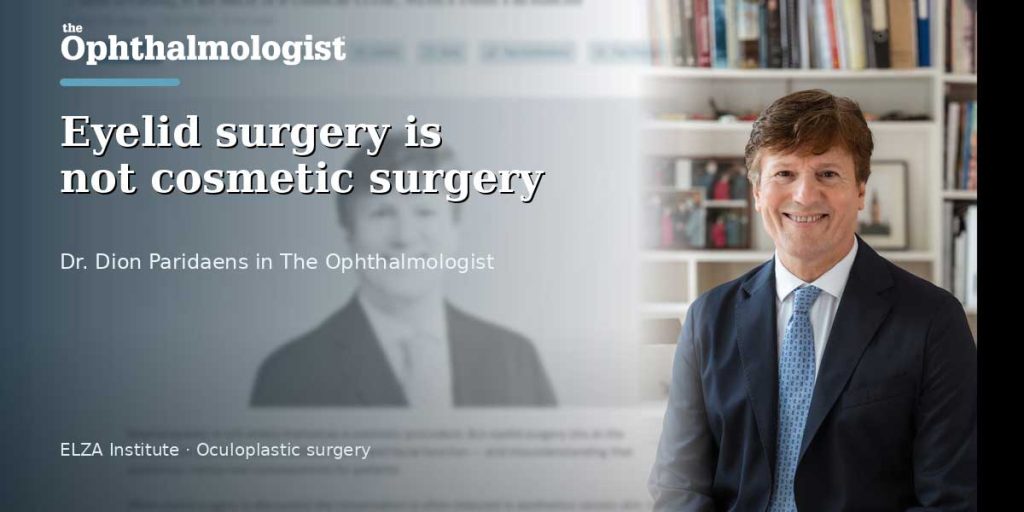
For patients considering eyelid surgery in Zurich – and beyond – blepharoplasty is often first understood in cosmetic terms: excess skin, tired-looking eyes, facial ageing, or a desire for a fresher appearance. However, in a newly published article in The Ophthalmologist, Dr. Dion Paridaens, MD, PhD, Consultant Oculoplastic Surgeon at the ELZA Institute, explains why this view is incomplete.
His article, “Eyelid Surgery is Not Cosmetic Surgery”, argues that eyelid surgery should not be treated as a purely aesthetic intervention. The eyelids protect the eye, support tear-film stability, maintain visual comfort, and contribute to clear vision. Surgery in this region therefore requires detailed knowledge of both eyelid anatomy and ocular function.
Why eyelid surgery affects more than appearance
The eyelids are active, functional structures. Every blink helps spread the tear film, protect the cornea, and maintain ocular surface health. Lid position, lid tension, and eyelid contour all influence how well the eye is protected during the day and during sleep.
This is why eyelid surgery differs from many other procedures that are usually described as aesthetic. A small change in eyelid height, contour, or closure can affect blinking, tear evaporation, corneal exposure, and comfort. In some patients, these changes may contribute to postoperative dryness, irritation, light sensitivity, visual fluctuation, or exposure symptoms.
Blepharoplasty must be planned around ocular function
Blepharoplasty is often described as the removal of excess eyelid skin or fat. In reality, careful assessment is required before surgery. The surgeon must consider the ocular surface, tear film, eyelid position, brow position, facial anatomy, and any pre-existing dry eye symptoms.
This is particularly important in patients with dermatochalasis, or hooded eyelids, where upper eyelid skin may interfere with comfort, appearance, and in some cases the visual field. Surgery may improve eyelid contour, but the aim should be to preserve natural eyelid function and protect the ocular surface.
The role of an oculoplastic surgeon
Dr. Paridaens emphasizes that oculoplastic surgeons are trained first as ophthalmologists. Their surgical planning is therefore shaped by an understanding of eye disease, visual physiology, microsurgery, dry eye disease, lid malposition, lacrimal disorders, orbital disease, and the management of complications.
This background is clinically relevant for patients considering oculoplastic surgery or blepharoplasty. Aesthetic outcome remains important, but it should not be separated from blink mechanics, tear-film stability, corneal protection, and long-term ocular comfort.
Why experience matters in eyelid surgery
Eyelid surgery is technically demanding because the operating field is small, tissue is limited, and revision surgery can be complex. A few millimetres of overcorrection or undercorrection may affect both appearance and function.
At the ELZA Institute, eyelid and eyebrow surgery is approached with attention to both functional and aesthetic outcomes. Dr. Paridaens brings extensive experience in oculoplastic, lacrimal, and orbital surgery, including complex reconstruction, tumour surgery, trauma, and revision cases.
A patient-centred message
For patients considering eyelid surgery in Zurich, the message of Dr. Paridaens’ article is clear: eyelid surgery should not be viewed only as cosmetic surgery. It should be assessed in the context of eye health, ocular surface protection, blinking, tear-film function, and long-term comfort.
The goal is not simply to change how the eyelids look. It is to ensure that the eyelids continue to protect the eye, support vision, and remain comfortable over time.
Read Dr. Paridaens’ full article in The Ophthalmologist: Eyelid Surgery is Not Cosmetic Surgery.
Eyelid Surgery in Zurich – come to ELZA
- Consultant-led oculoplastic care from Dr. Dion Paridaens, MD, PhD, an internationally recognised eyelid, lacrimal, and orbital surgeon.
- Eyelid surgery planned around both appearance and ocular function, including blinking, tear-film stability, corneal protection, and comfort.
- Specialist assessment for blepharoplasty, dermatochalasis, eyelid malposition, lacrimal problems, and complex revision cases.
- Ophthalmology-based surgical planning, with attention to dry eye, ocular surface health, visual function, and long-term safety.
- Conveniently located in Zurich, with multidisciplinary eye-care expertise available within the ELZA Institute.
