
Can a singular, decades-old protocol sustain its position as the clinical benchmark in an era oriented toward individualized care? For over twenty years, the Dresden protocol has anchored the practice of CXL, offering a predictable, albeit rigid, framework for keratoconus stabilization. Yet, as our understanding of the procedure’s photochemical constraints deepens—specifically the dynamic interplay between ultraviolet-A (UV-A) irradiance, riboflavin kinetics, and stromal oxygen availability—the clinical limitations of a uniform approach are becoming increasingly difficult to ignore.
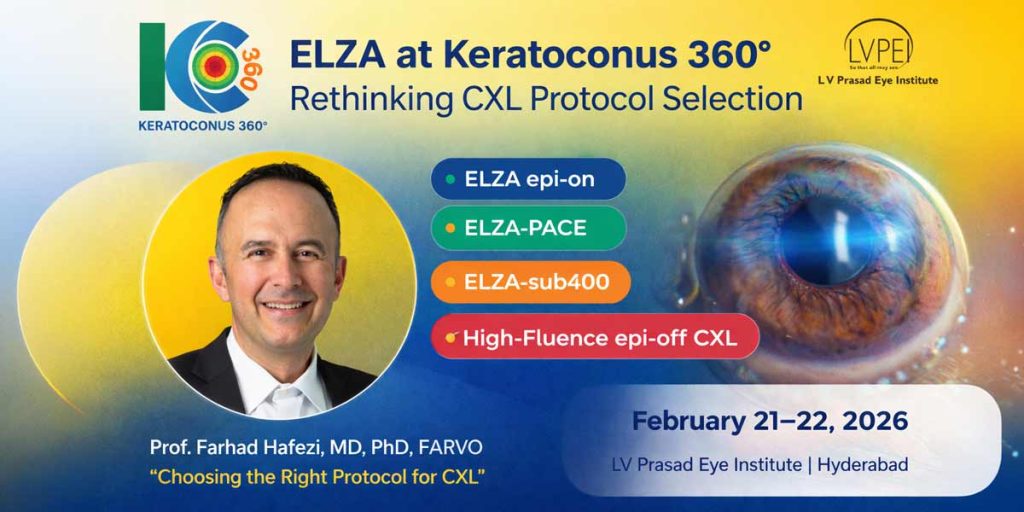
At the Keratoconus 360 conference that took place yesterday in Hyderabad, India, the discussion surrounding CXL has shifted from mere stabilization to the nuances of protocol selection. Representing the ELZA Institute, Prof. Farhad Hafezi, MD, PhD, FARVO addressed the central tension facing modern corneal surgeons: the balance between the proven longitudinal efficacy of traditional methods and the emerging clinical necessity for individualized therapy.
The Oxygen Constraint and High-Fluence Evolution
The historical reliance on the 3 mW/cm² irradiance for 30 minutes was, in part, a product of the technical limitations of 1990s LED technology. Modern high-fluence accelerated CXL (A-CXL) seeks to replicate the biomechanical strengthening of the Dresden protocol in a fraction of the time. However, data suggest that simply increasing irradiance while reducing time – maintaining a reciprocal 5.4 J/cm² fluence – often results in a shallower demarcation line and reduced stiffening.
This “reciprocity failure” is primarily attributed to oxygen depletion. Recent evidence, including work discussed by ELZA faculty, suggests that protocols delivering higher total fluence (e.g., 7.2 J/cm² or 10 J/cm²) at specific irradiances may be required to achieve Dresden-equivalent outcomes. The transition to “ELZA High-Fluence” epi-off protocols reflects this shift, moving toward a model where energy delivery is optimized to match the biological and chemical constraints of the stroma rather than an arbitrary historical standard.
Beyond the 400 µm Barrier
Perhaps the most significant departure from traditional constraints is the management of the ultrathin cornea. For years, the 400 µm threshold was an absolute contraindication for CXL, leaving patients with advanced ectasia with few options beyond keratoplasty. The development of the ELZA-sub400 protocol—now in its second generation—represents a move toward “adapting the technique to the cornea” rather than the inverse.
By utilizing an algorithm based on the Lambert-Beer law and Fick’s law of diffusion, clinicians can now adjust UV-A fluence according to intraoperative pachymetry. This ensures that the UV-A dose at the endothelial level remains below the recognized damage threshold, even in corneas as thin as 214 µm. While 12-month and 24-month data indicate a 90% success rate in halting progression, the long-term question remains: how much biomechanical reserve is sufficient to prevent late-stage failure in these high-risk eyes?
From Stabilization to Functional Regularization
The introduction of ELZA-PACE (PTK-assisted customized epi-on CXL) suggests a third pillar of evolution: CXL as a refractive tool. Rather than applying uniform energy across the entire corneal surface, customized protocols utilize topography-guided or epithelial thickness-driven UV-A gradients. The goal is to induce focal flattening at the cone apex to regularize the corneal optics.
While the prospect of visual improvement without stromal tissue removal is compelling, it introduces a new layer of complexity. The “coupling effect”, where flattening in one area leads to steepening elsewhere, requires sophisticated biomechanical modeling to predict. Current evidence supports significant flattening effects, but the predictability of refractive outcomes remains less robust than the stability outcomes of standard CXL.
Individualized corneal cross-linking protocols
As the field moves toward a more granular, patient-specific approach, the challenge for the clinician is no longer just whether to cross-link, but which specific photochemical environment to create. Whether these individualized protocols will eventually supersede the Dresden protocol entirely, or remain specialized tools for complex cases, depends on the accumulation of multi-center, long-term comparative data that match the rigor of the original 2003 findings.

