Cross-Linking extremely thin corneas

The original Dresden protocol allows CXL to be performed safely when the thickness of the cornea is 400 μm or higher. However, in advanced cases of keratoconus, pellucid marginal degeneration and post-LASIK ectasia, the cornea may be thinner.

Thin and Ultra-Thin Cornea CXL: ELZA's Pioneering Research

Since 2009, ELZA’s surgeons and researchers have been leading advances in corneal cross-linking (CXL) for thin corneas.

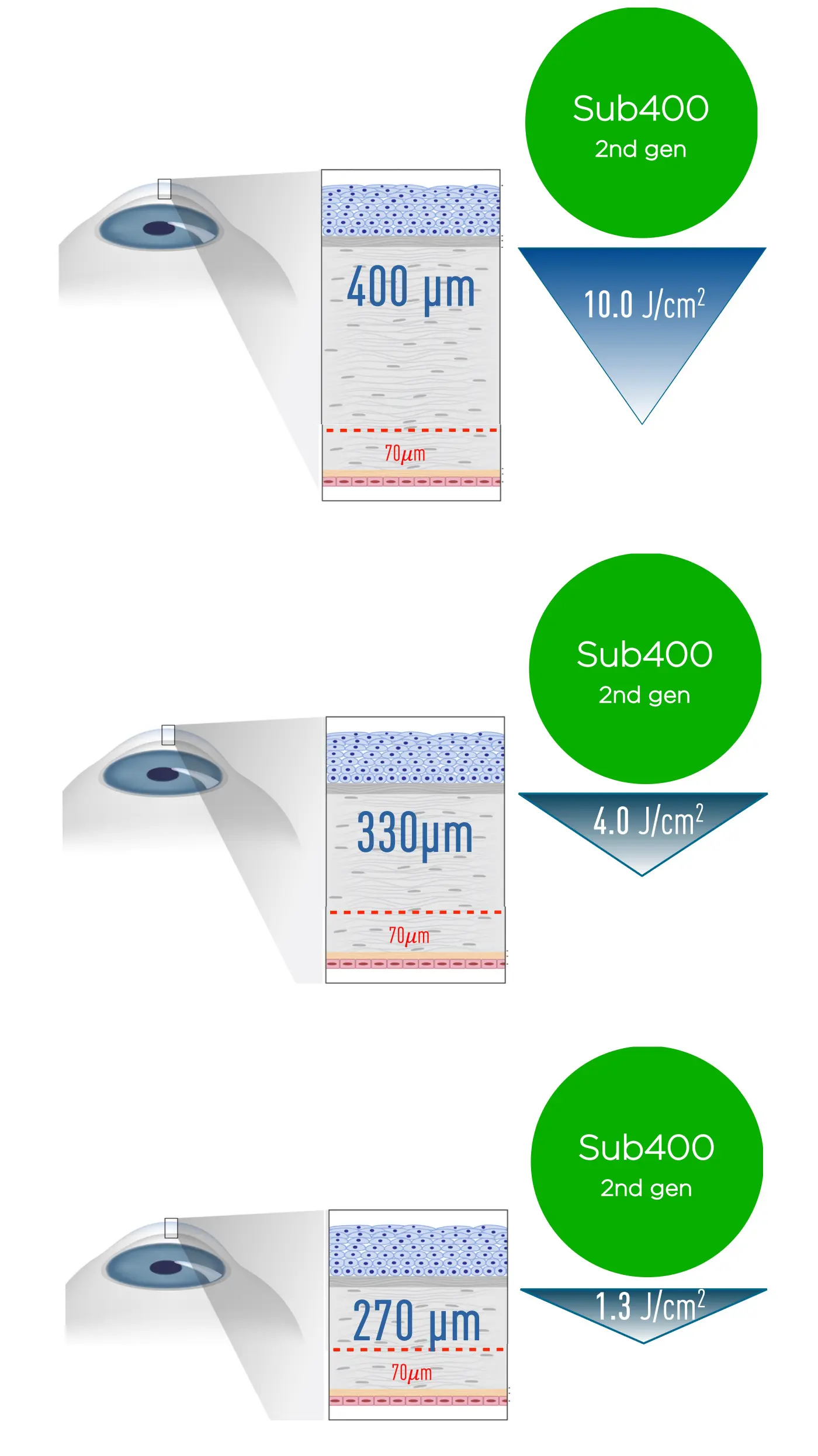
Thin (<400 µm) and ultra-thin (≤220 µm) corneas have long presented a treatment challenge because of minimum thickness safety limits intended to protect the corneal endothelium from ultraviolet (UV) damage. The original “Dresden protocol” excluded corneas thinner than 400 µm to safeguard these endothelial cells, which are essential for nourishing the cornea and maintaining its transparency by regulating hydration. Importantly, these cells do not regenerate once damaged by UV exposure. At the time the Dresden protocol was developed, a 70 µm uncross-linked stromal safety margin was calculated as necessary to prevent UV-induced endothelial injury.

Our pioneering research has led to innovative protocols that safely and effectively treat corneas well below this 400 µm threshold, culminating in the current state-of-the-art ELZA-sub400 protocol.

Understanding Thin Corneas in Keratoconus

Keratoconus – and related corneal ectasias, including post-LASIK ectasia – cause progressive thinning. In the past, if detected late, cornea that had thined to less than 400 µm were excluded from receiving Dresden protocol CXL.

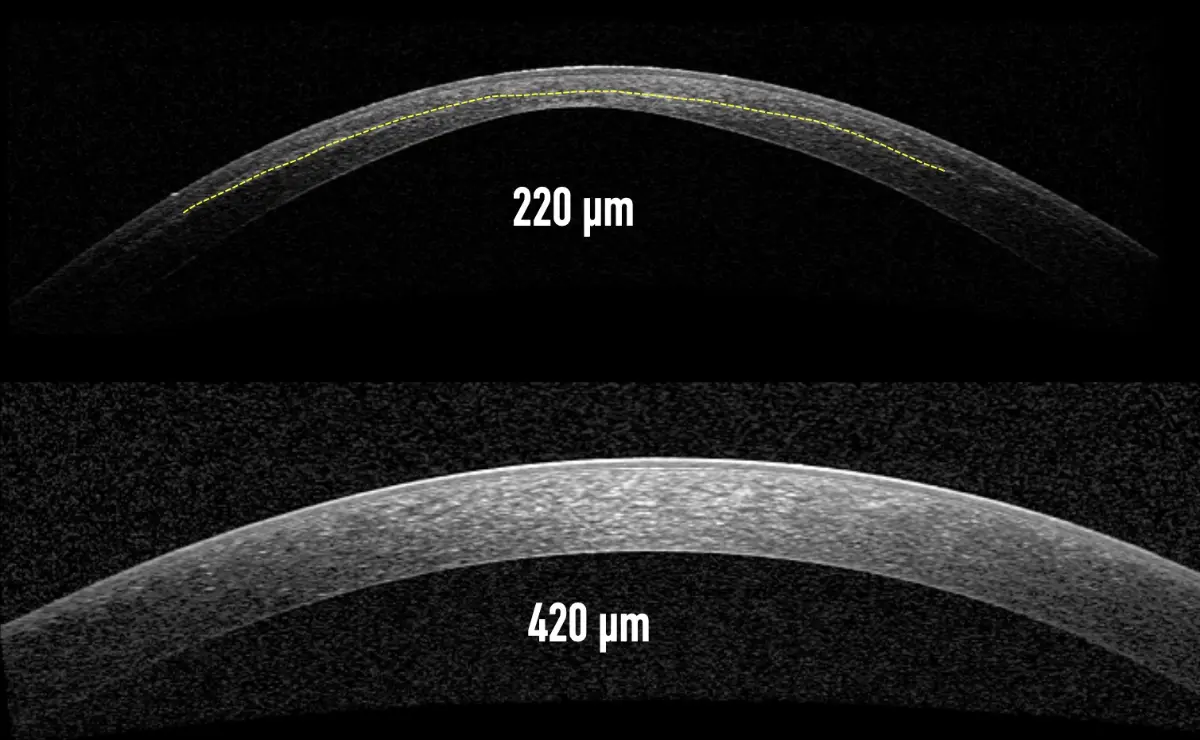
The optical coherence tomography image below illustrates this challenge: two corneas are shown: one 220 µm thick (top) and one 420 µm thick (bottom). Only the thicker cornea could be cross-linked, despite the thinner one requiring treatment the most.

Overcoming the 400 µm Limit: Hypoosmolar Riboflavin

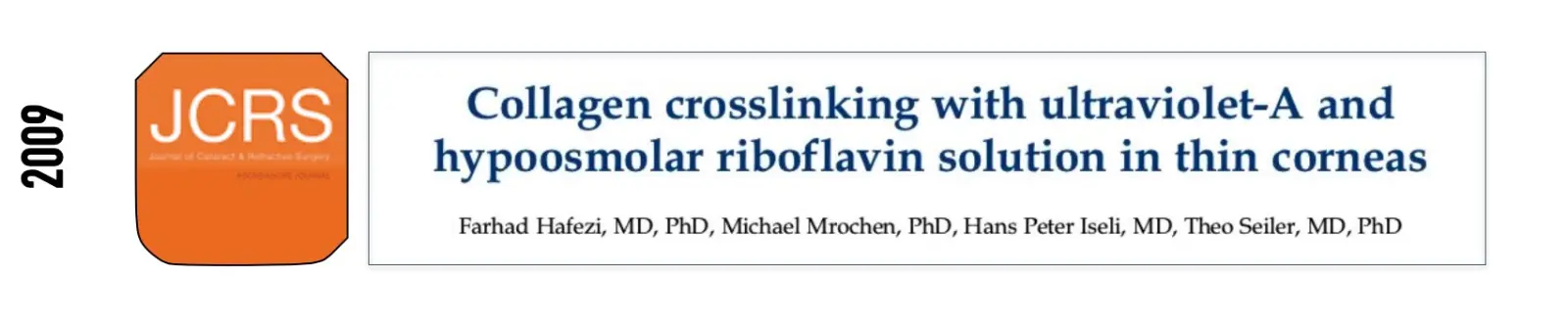
In 2009, Prof. Hafezi and colleagues introduced hypoosmolar riboflavin, which transiently swells thin corneas to a safer thickness, allowing CXL without risking endothelial damage. Although this approach was widely adopted, this method’s variability in corneal swelling response poses challenges: insufficient swelling in some patients means that the treatment cannot go ahead.

Other thin cornea CXL protocols have been developed, such as contact lens–assisted CXL, where a riboflavin-soaked contact lens is placed on the cornea to artificially increase its thickness during UV irradiation. However, this method produces less biomechanical strengthening than hypoosmolar riboflavin, because, as explained below, the contact lens acts as a barrier that reduces oxygen diffusion into the cornea.
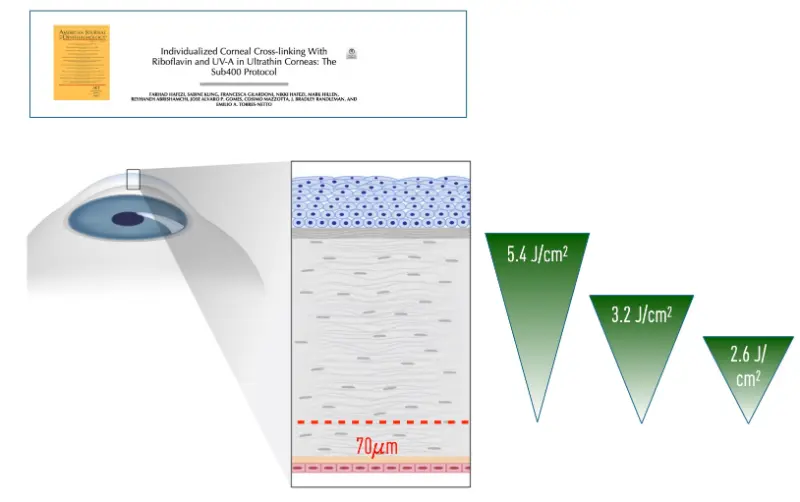
Modelling the Role of Oxygen, Riboflavin, and UV Light

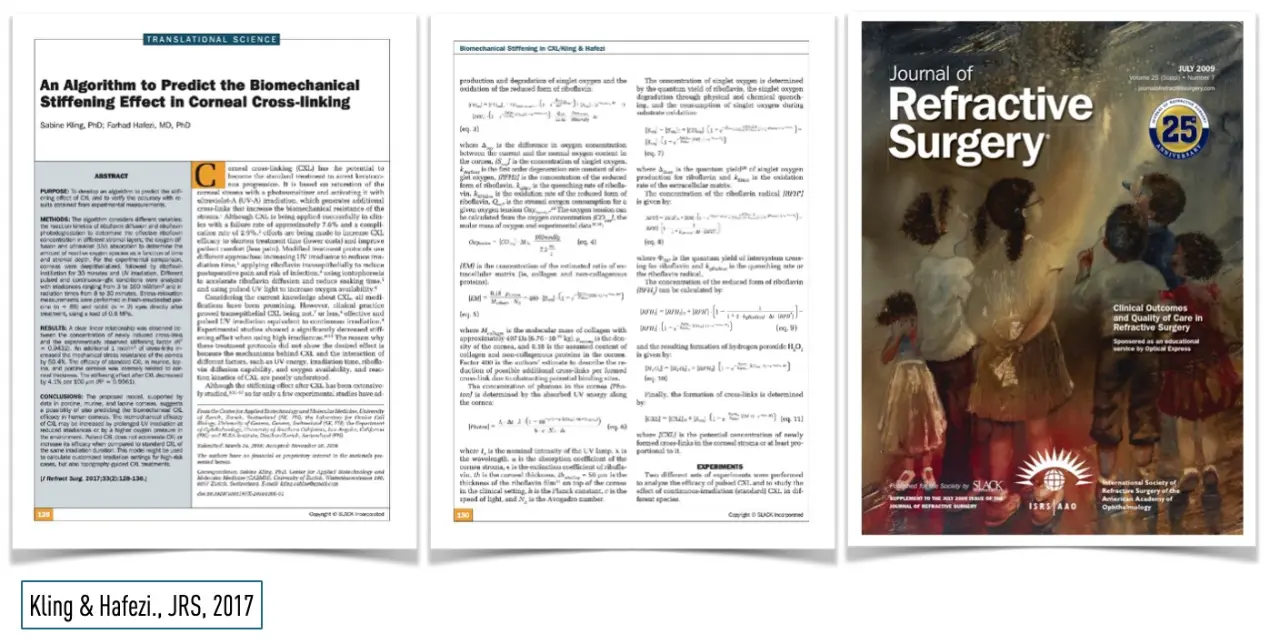
CXL relies on a photochemical reaction. In epi-off CXL, the corneal epithelium is removed so riboflavin (vitamin B2) saturates the stroma, the cornea’s main structural layer. UV energy then activates riboflavin and stromal oxygen, generating reactive oxygen species (ROS) that induce cross-links between collagen fibrils, strengthening the cornea. Oxygen is rate-limiting, influencing cross-linking depth and efficacy. Understanding and modelling these reagent interactions has formed the foundation of modern thin cornea CXL approaches. ELZA and collaborator Dr. Sabine Kling published this modelling algorithm in 2017.

The ELZA-sub400 Protocol

By modelling the entire photochemical reaction, we quantify how much cross-linking a given UV energy dose achieves. Thus, UV fluence can be adjusted by altering exposure duration. Measuring corneal thickness at its thinnest point allows tailoring UV irradiation time to maximize cross-linking while maintaining a minimum 70 µm safety margin of uncross-linked, riboflavin-saturated stroma above the endothelium – optimizing efficacy and safety.

Clinical Impact: CXL Depth and Safety in Ultra-Thin Corneas

The sub400 protocol achieves cross-linking depths customized to corneal thickness, often less than the ~330 µm effect in thicker corneas treated with the Dresden protocol. This tailored fluence minimizes endothelial UV exposure while ensuring biomechanical strengthening. Clinical studies at ELZA report a 90% success rate in halting progression in corneas as thin as 214 µm, with no endothelial damage or decompensation.

In 2026, we published a second-generation ELZA-sub400 protocol for patients with more advanced, rapidly progressive disease. It raises the maximum UV fluence to about 10 J/cm² and adds a faster, accelerated option, cutting treatment time from about 30 to 18 minutes. In a 12-month study of 29 eyes with more severe baseline disease than the first-generation cohort, it halted progression in 76% of eyes, with no endothelial decompensation and no deep stromal haze — a lower rate than the first generation’s, reflecting the more advanced disease treated rather than reduced efficacy. As before, the goal is to preserve the patient’s own cornea; ELZA is also developing an epithelium-on (epi-on) approach to further extend treatment options for thin corneas.

Summary: ELZA’s Leadership in Thin Cornea CXL

  • Pioneered hypoosmolar riboflavin to safely expand treatment eligibility.
  • Developed the sub400 protocol offering individualized, thickness-based UV fluence adjustment.
  • Enabled safe treatment of corneas thinner than 400 µm, including those as thin as 214 µm.
  • Integrated photochemical principles with clinical innovation, emphasizing the critical role.
  • Published a second-generation ELZA-sub400 protocol (2026), extending treatment to more advanced disease with a higher fluence ceiling and a faster accelerated option.
  • Advancing epithelium-on (epi-on) cross-linking to further broaden treatment options for thin and ultra-thin corneas.

Discover how ELZA’s scientific rigor and clinical expertise continue to redefine safety and effectiveness standards in thin cornea cross-linking.

References

  1. Hafezi F, Mrochen M, Iseli HP, Seiler T. Collagen crosslinking with ultraviolet-A and hypoosmolar riboflavin solution in thin corneas. J Cataract Refract Surg. 2009;35(4):621-624.
  2. Jacob S, Kumar DA, Agarwal A, Basu S, Sinha P, Agarwal A. Contact lens-assisted collagen cross-linking (CACXL): A new technique for cross-linking thin corneas. J Refract Surg. 2014;30(6):366-372.
  3. Mazzotta C, Ramovecchi V. Customized epithelial debridement for thin ectatic corneas undergoing corneal cross-linking: epithelial island cross-linking technique. Clin Ophthalmol. 2014;8:1337-1343.
  4. Hafezi F, Kling S, Gilardoni F et al. Individualized corneal cross-linking with riboflavin and UV-A in ultra-thin corneas: the sub400 protocol. Am J Ophthalmol. 2021; 224:133–142.
  5. Kling S, Richoz O, Hammer A, et al. Increased biomechanical efficacy of corneal cross-linking in thin corneas due to higher oxygen availability. J Refract Surg. 2015;31(12):840-846.
  6. Kling S, Hafezi F. An algorithm to predict the biomechanical stiffening effect in corneal cross-linking. J Refract Surg. 2017;33(2):128-136.
  7. Hafezi F, Akcan RE, Kling S, et al. Second-generation ELZA-sub400 protocol: individualized high-fluence cross-linking for ultra-thin keratoconus corneas. Am J Ophthalmol. 2026. doi:10.1016/j.ajo.2026.06.034.

ELZA’s Publications: Cross-linking

A new Die Ophthalmologie review explains ELZA-sub400 cross-linking, an individualised protocol that fits the UV dose to each cornea, making cross-linking possible in keratoconus corneas as thin as 214 µm.
Prof. Farhad Hafezi presented five-year outcomes and future directions of the sub400 protocol for thin cornea CXL at the KCXL Experts’ Meeting 2025 in Milan.
Prof. Hafezi presented new insights on PACK-CXL, ELZA-PACE, and epi-on CXL at EPOMEC 2025, shaping future keratoconus management.
Keratoconus affects not only the cornea but also the retina, choroid, and optic nerve head, as shown in a meta-analysis co-authored by Prof. Farhad Hafezi.
Highlights from ESCRS 2025 ELZA Institute Sunday sessions in Copenhagen, featuring advances in keratoconus, glaucoma, and corneal surgery

Contacts

Get in touch

Call Us

During office hours.

On-site Appointment

Make an appointment, and come to see us.

Recommend Us

Thank you for writing a review on google.

ELZA International

International Patients

Contact us here, we will get in touch with you.

Online Consultation

Zoom online consultation for our international patients.

Why ELZA?

Our Doctors

Contact us here, we will get in touch with you.

Global Reputation

Contact us here, we will get in touch with you.

.
.