
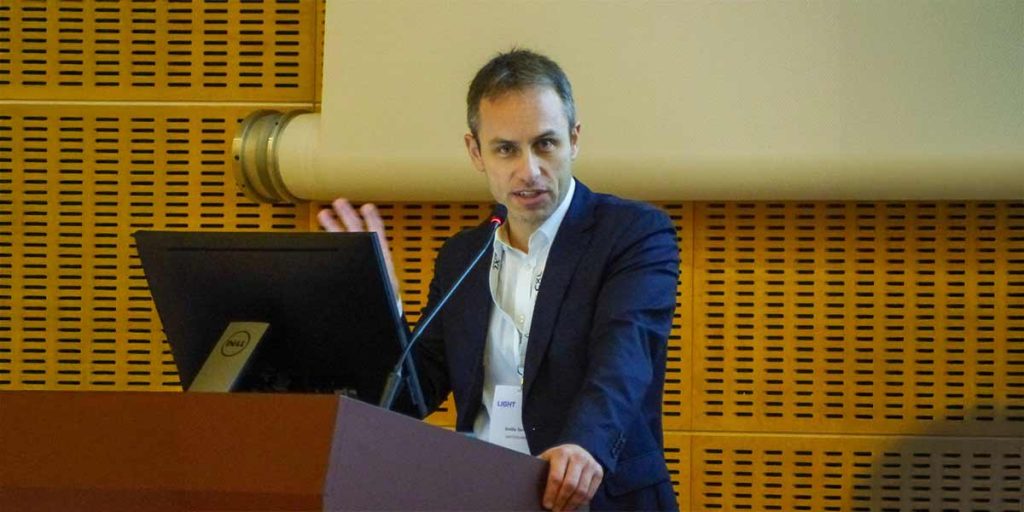
At the KCXL Experts’ Meeting 2025, held in Milan on 12 December 2025, ELZA’s cataract, refractive and corneal surgeon Dr. Emilio Torres-Netto, MD, PhD, FEBO, FWCRS, presented a detailed analysis of the evolution of epi-on CXL, focusing on why early protocols failed and how contemporary approaches have addressed these limitations through physiological optimisation.
Dr Torres-Netto began by revisiting the historical role of epi-off CXL, which remains a highly effective method for stabilising progressive keratoconus. However, epithelial removal is associated with well-recognised drawbacks, including postoperative pain, delayed re-epithelialisation, haze, and—rarely—sterile melting or infection. These limitations provided the original rationale for developing epi-on approaches.
Early epi-on CXL protocols, however, produced unsatisfactory clinical outcomes. Simply preserving the epithelium while applying conventional CXL parameters resulted in continued progression, with increases in Kmax and further corneal thinning reported in early studies. Dr Torres-Netto emphasised that these failures were not surprising, as the intact epithelium fundamentally alters the photochemical environment required for effective CXL.
With the epithelium in place, UV transmission is attenuated, riboflavin penetration is reduced, and oxygen availability is limited, further compounded by epithelial oxygen consumption. Attempts to address these issues in isolation—such as modifying riboflavin formulations, increasing concentration, or adding penetration enhancers—proved insufficient. In several studies, epithelial defects still occurred despite “epi-on” treatment, and biomechanical stabilisation remained inadequate.
A central theme of the presentation was that effective epi-on CXL requires simultaneous optimisation of all critical reaction parameters. Dr Torres-Netto reviewed experimental and clinical data showing that addressing a single limiting factor does not reproduce the biomechanical effect of epi-off CXL. Proof-of-concept work using very low irradiance and prolonged exposure demonstrated partial stiffening, but results remained inferior when the epithelium was thick.
Subsequent advances marked a turning point. Modern epi-on protocols combine strategies to enhance stromal riboflavin availability, compensate for epithelial UV attenuation, and respect the oxygen dependency of the CXL reaction. Clinical data presented demonstrated consistent demarcation line formation at approximately 220 µm, with stable Kmax and corneal thickness at one-year follow-up.
Dr Torres-Netto highlighted that these contemporary epi-on CXL approaches are particularly relevant for patients with documented progression and good baseline visual acuity, where minimising pain, haze, and epithelial complications is desirable. Longer-term case examples showed sustained stabilisation over several years, including in advanced keratoconus, although with less flattening than typically observed after epi-off CXL.
He concluded that early epi-on CXL failures reflected incomplete physiological compensation rather than flawed concepts. With current-generation protocols addressing all limiting factors together, epi-on CXL has become a clinically meaningful option in carefully selected patients.
The full presentation from the KCXL Experts’ Meeting 2025 can be viewed below.

