
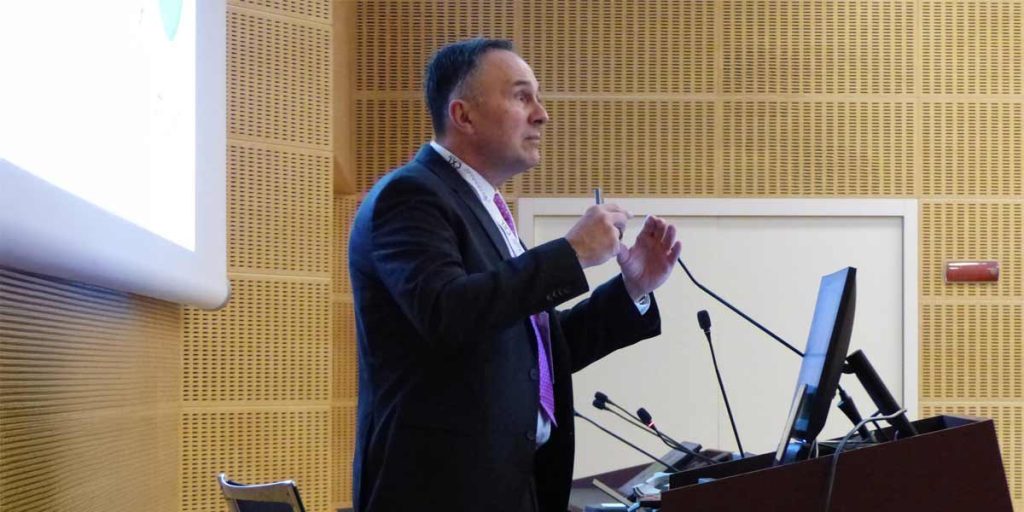
On 12 December 2025, ELZA Institute’s Medical Director, Prof. Farhad Hafezi, MD, PhD, FARVO, presented at the KCXL Experts’ Meeting 2025 in Milan, focusing on the future of CXL in ultra-thin corneas and the continued evolution of the sub400 protocol.
From Fixed Thickness to Tissue-Adapted CXL for thin cornea CXL
Prof. Hafezi began by revisiting the foundations of modern CXL. The original Dresden protocol, established more than two decades ago, defined 400 µm stromal thickness as a safety threshold for standard epi-off CXL. However, clinical reality frequently presents progressive keratoconus in significantly thinner corneas, including corneas well below 300 µm.
Early strategies to address this challenge relied on artificially increasing corneal thickness, either by stromal swelling using hypotonic riboflavin or by adding tissue via a contact lens. While both approaches enabled treatment below 400 µm, Prof. Hafezi explained why neither represents an optimal long-term solution. Stromal swelling is highly unpredictable, making intraoperative decision-making difficult, while contact lens–assisted CXL introduces a significant oxygen diffusion barrier, resulting in a measurable reduction in CXL efficacy.
Adapting the Technique to the Tissue
Rather than adapting the cornea to a fixed protocol, Prof. Hafezi outlined a paradigm shift: adapting the CXL fluence to the individual corneal thickness. This concept led to the development of the sub400 algorithm, first introduced in 2017 and later published as a first-generation sub400 protocol.
The principle is straightforward but physiologically grounded. After epithelial removal and riboflavin saturation, the minimal stromal thickness is measured immediately before UV irradiation. Based on this value, the total fluence is adjusted, ensuring a consistent posterior safety margin of approximately 70 µm, thereby avoiding endothelial toxicity. In a 400 µm cornea, standard fluence is applied; in thinner corneas, fluence is progressively reduced.
Importantly, Prof. Hafezi emphasized that the protocol is open technology, freely available, and usable with any UV device capable of delivering the required irradiance.
Long-Term Outcomes and Second-Generation sub400
Five-year data now demonstrate an 80% success rate in stabilizing progression, even in extremely advanced corneas, including cases approaching 90 diopters. These outcomes, Prof. Hafezi noted, are particularly meaningful in patients who retain functional vision with scleral or rigid contact lenses, where stabilization alone can preserve quality of life.
Building on this foundation, a second-generation sub400 protocol has been developed. This updated nomogram uses higher fluence (up to 10 J/cm² at 400 µm) with moderate acceleration, while maintaining the same thickness-adapted safety principles. One-year clinical data are complete and currently being prepared for submission.
Looking Ahead: Epi-On sub400
Prof. Hafezi concluded by outlining ongoing work toward combining epi-on CXL concepts with sub400 logic, particularly for extremely thin and irregular corneas where epithelial healing may be problematic. Development is ongoing, with further clinical validation expected over the coming years.
Watch the Presentation
The full presentation from the KCXL Experts’ Meeting 2025 can be viewed below.
