
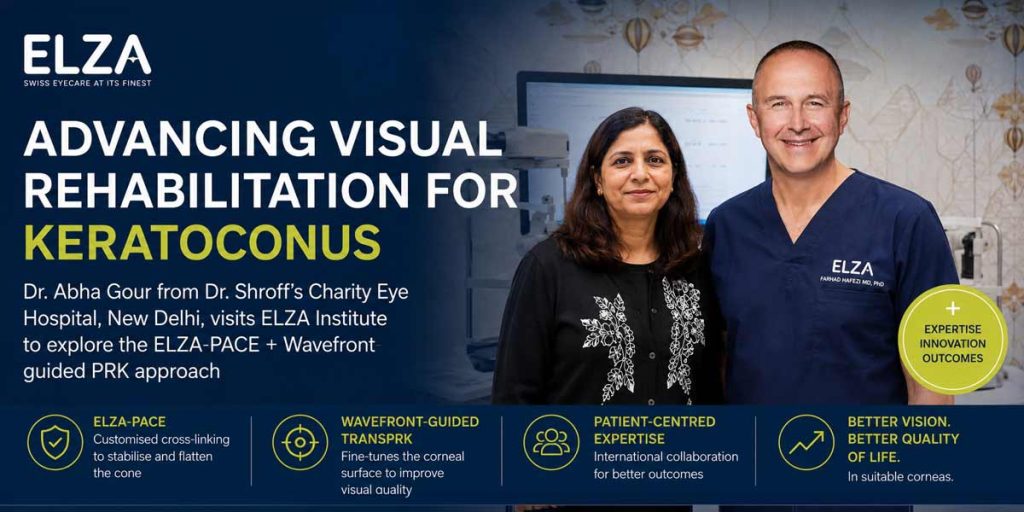
A clinical exchange focused on stabilising and improving keratoconic corneas
ELZA recently welcomed Dr Abha Gour from Dr Shroff’s Charity Eye Hospital in New Delhi for a clinical exchange focused on visual rehabilitation in keratoconus. Dr Gour is listed by Dr Shroff’s Charity Eye Hospital as a Consultant in Cornea, Refractive Surgeries and Anterior Segment, with specialist interests including pediatric cornea, refractive surgery, research, VKC, cornea and ocular surface regeneration.
Her visit to ELZA centred on an increasingly important question in keratoconus care: once the disease has been stabilised, how much visual function can be recovered in suitable corneas?
Keratoconus treatment has traditionally focused on halting progression. This remains essential, because progressive biomechanical weakening can lead to increasing irregular astigmatism, visual distortion, contact lens intolerance and, in advanced cases, corneal transplantation. However, modern keratoconus care is no longer limited to stabilisation alone. At ELZA, selected patients may undergo a staged approach designed to stabilise the cornea, regularise its shape and improve visual quality.
ELZA-PACE: customised cross-linking with keratoconus visual rehabilitation in mind
ELZA-PACE is a customised form of corneal cross-linking developed to treat the keratoconic cone more selectively. Unlike conventional cross-linking, which applies treatment more uniformly, ELZA-PACE uses controlled gradients in epithelial removal, riboflavin distribution, oxygen availability and UV-A fluence. The aim is to strengthen and flatten the steepest part of the cone while preserving surrounding tissue. ELZA describes this approach as a way to improve corneal regularity and visual quality without removing stromal tissue.
This matters because keratoconus causes visual symptoms not only through myopia or astigmatism, but also through higher-order aberrations. Patients may describe ghosting, halos, double images, blur or poor night vision, even when standard glasses provide partial correction.
In suitable corneas, ELZA-PACE can therefore be used not only to stop progression, but also to create a more regular optical surface. This can make subsequent visual rehabilitation more effective.
Wavefront-guided TransPRK: fine-tuning the optical surface
After the cornea has stabilised, some patients may benefit from corneal wavefront-guided TransPRK. This is not standard laser vision correction for routine myopia. In keratoconus, it is used selectively and conservatively to reduce irregular astigmatism and higher-order aberrations caused by the distorted corneal surface.
ELZA’s keratoconus information explains that wavefront-guided TransPRK can be used in suitable corneas to “fine-tune” vision by reducing optical aberrations such as blurring, ghosting and double vision. ELZA also notes that corneal wavefront-guided PRK for keratoconus is intended to improve visual quality by selectively treating higher-order wavefront errors.
The staged approach is important. First, the keratoconus must be stabilised. Then, once the cornea is suitable and sufficiently stable, wavefront-guided TransPRK may be considered to improve optical quality. In many cases, the goal is not spectacle independence, but better functional vision, improved contrast, reduced distortion and improved tolerance of glasses or contact lenses.
Who may benefit?
Visual rehabilitation in keratoconus is highly individual. Not every cornea is suitable for ELZA-PACE, TransPRK or combined treatment. Decisions depend on corneal thickness, cone location, scarring, disease stage, epithelial profile, tomographic stability, visual symptoms and patient expectations.
Potential candidates may include patients with progressive or previously stabilised keratoconus who have irregular astigmatism, reduced visual quality or contact lens difficulties, but who still have sufficient corneal thickness and no advanced central scarring. ELZA’s keratoconus page describes several surgical options for improving vision in keratoconus, including corneal wavefront-guided TransPRK, ELZA-PACE, All Femto-CAIRS and Femto ICRS, with staged treatment sometimes used to enhance vision after an initial procedure.
International collaboration in corneal rehabilitation
Dr Gour’s visit reflects the international nature of modern keratoconus care. Dr Shroff’s Charity Eye Hospital has a long-standing cornea and anterior segment service in New Delhi, while ELZA has developed a clinical and research focus on customised cross-linking, corneal biomechanics and keratoconus rehabilitation.
The shared clinical interest is clear: earlier diagnosis, safer stabilisation and better visual rehabilitation for patients whose daily vision is affected by keratoconus.
For selected patients, the combination of ELZA-PACE and corneal wavefront-guided TransPRK may help move treatment beyond stabilisation alone, towards a more regular cornea and better visual quality. The key phrase remains “in suitable corneas”: careful selection, conservative planning and long-term stability remain central to responsible keratoconus care.

