
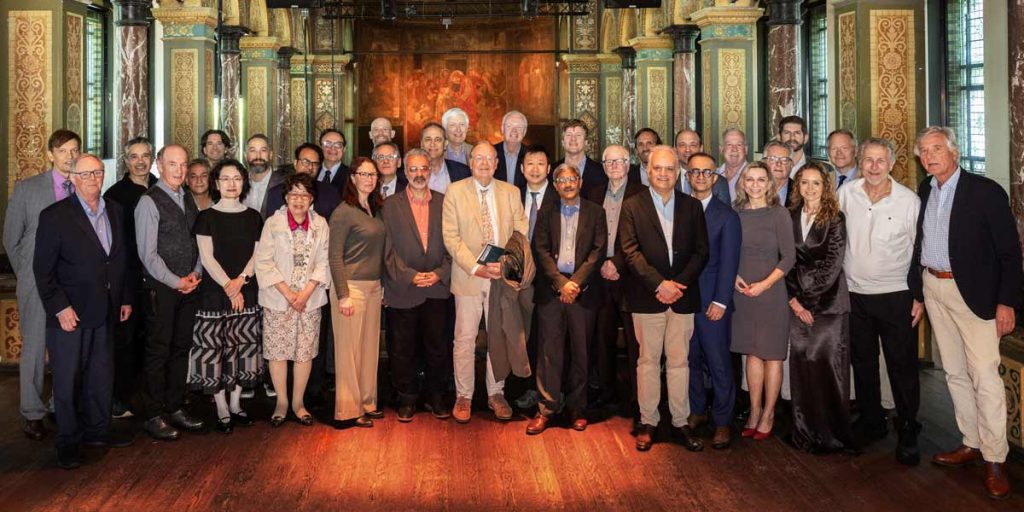
Dr. Dion Paridaens, MD, PhD, Consultant Oculoplastic and Orbital Surgeon at the ELZA Institute, recently participated in the International Orbital Society Meeting, held on 21–22 May 2026 at the Hotel Arena in Amsterdam. The meeting brought together a selective international group of specialists in orbital surgery, oculoplastic surgery, ophthalmology, and related disciplines for two days of scientific exchange and clinical discussion. Dr. Paridaens reported that the meeting was organised by Prof. Peerooz Saeed and held in the former chapel of Hotel Arena, a historic Amsterdam venue linked to a Catholic orphanage built in 1886.
A specialist meeting dedicated to orbitology
Orbitology is a highly specialised field concerned with diseases and surgery of the orbit: the anatomical space containing the eye, extraocular muscles, optic nerve, vessels, nerves, connective tissues, and lacrimal structures. Orbital disease can involve inflammation, trauma, thyroid eye disease, vascular abnormalities, and benign or malignant tumours. Management often requires close collaboration between ophthalmology, oculoplastic surgery, radiology, oncology, pathology, neurosurgery, and maxillofacial or ENT surgery.
The International Orbital Society Meeting provides a focused setting for discussion of these complex conditions. Unlike broad ophthalmology congresses, meetings of this kind allow subspecialists to examine rare presentations, technical decisions, and multidisciplinary treatment pathways in depth.
Presenting a complex orbital tumour case
At the meeting, Dr. Paridaens presented what he described as a first case of successful primary stereotactic radiotherapy for a biopsy-proven solitary fibrous tumour of the orbit. In this patient, surgical excision would have carried a high risk of serious functional complications, including possible loss of vision in the better-seeing eye.
Solitary fibrous tumours of the orbit are uncommon lesions, and treatment decisions depend on tumour location, histology, symptoms, growth behaviour, and the expected risks of intervention. In selected cases, especially when surgery threatens vision or ocular function, non-surgical or organ-preserving treatment strategies may become clinically relevant. The case presented by Dr. Paridaens therefore illustrates the type of complex decision-making that defines modern orbital care.

Consultant-led oculoplastic and orbital care at ELZA
At ELZA, Dr. Paridaens provides consultant-led assessment and treatment for eyelid, lacrimal, and orbital conditions. His clinical work includes reconstructive and cosmetic eyelid surgery, ptosis, eyelid malpositions, eyelid tumours, tear-duct disorders, thyroid eye disease, and orbital surgery. ELZA’s profile notes that Dr. Paridaens manages the Department of Eyelid, Tear and Orbital Surgery at the Rotterdam Eye Hospital and works as a consultant surgeon for ELZA.
This subspecialist model matters because eyelid and orbital surgery is not only about appearance. The eyelids protect the ocular surface, support the tear film, contribute to comfort, and help preserve vision. Similarly, orbital disease can affect eye position, eye movement, optic nerve function, facial symmetry, and quality of life. Careful anatomical assessment and surgical planning are therefore essential.
Scientific exchange, clinical judgement, and patient care
Dr. Paridaens also moderated a session covering a broad range of orbital topics, including historical and philosophical perspectives on Baruch Spinoza presented by Prof. Eric Schliesser. The meeting highlighted the continuing value of small, expert-led scientific forums, where rare cases and difficult treatment decisions can be discussed in detail among experienced colleagues.
For ELZA patients, Dr. Paridaens’ participation in the International Orbital Society reflects the clinic’s commitment to specialist-led ophthalmic care. Complex eyelid and orbital disorders often sit at the intersection of function, anatomy, cosmesis, and vision. They require not only surgical experience, but also careful judgement about when surgery is appropriate, when conservative management is preferable, and when multidisciplinary alternatives should be considered.
Patients seeking assessment for eyelid, tear-duct, thyroid eye disease, or orbital problems can arrange a consultation with Dr. Dion Paridaens at the ELZA Institute in Zurich.
