ELZA at the World Keratoconus Congress 2026 in Florence
The World Keratoconus Congress 2026 in Florence was a deliberately focused meeting. Rather than dispersing attention across subspecialties, it followed keratoconus from early detection through to long-term management. The structure itself reflected where the field is heading: toward earlier diagnosis, more precise measurement, and treatments that are increasingly tailored to the individual cornea.
Within that framework, the contributions from Prof. Farhad Hafezi, MD, PhD, FARVO, and Dr. Emilio A. Torres-Netto, MD, PhD, FEBO, FWCRS sat at the centre of the discussion. In Prof. Hafezi’s presentation on ELZA-PACE cross-linking to improve vision in keratoconus, a change became apparent over the course of several sessions. Cross-linking is no longer regarded merely as a means of slowing progression. It is increasingly being researched as a method for the active, controlled reshaping of the cornea.
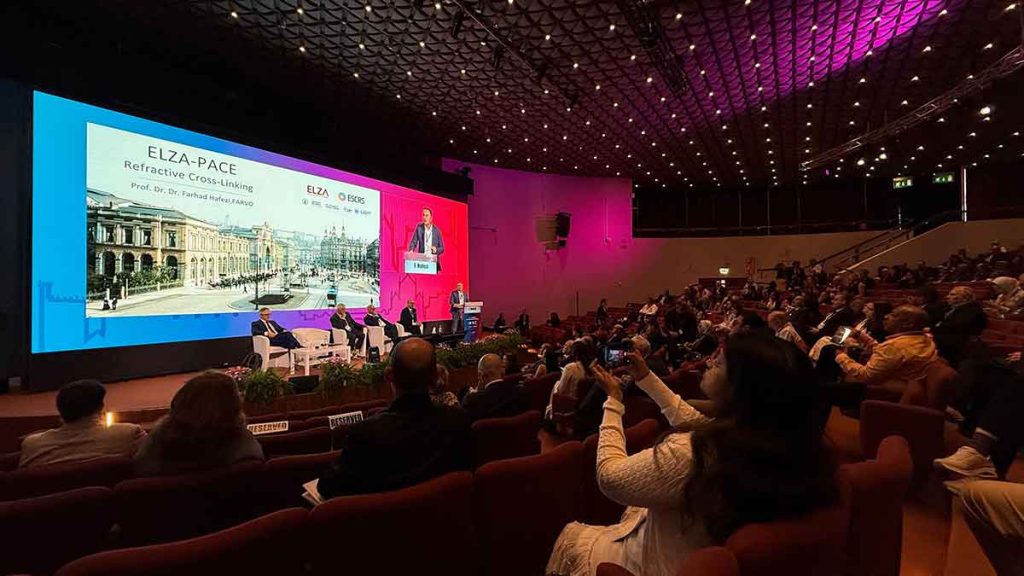
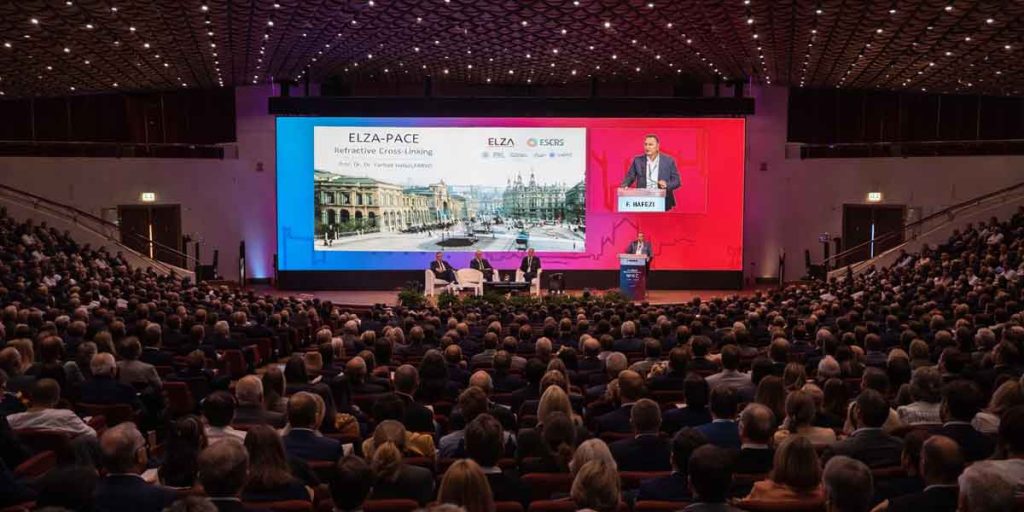
Prof. Hafezi on stage at the World Keratoconus Congress 2026 in Florence, Italy
The ELZA-PACE approach illustrates this change in thinking. Instead of applying uniform treatment across the cornea, it creates controlled gradients within it. By selectively removing epithelium over the cone and combining this with variations in riboflavin concentration, oxygen availability and UV energy, the treatment produces a stronger and more localised cross-linking effect where it is most needed. This allows the cone to flatten while preserving surrounding tissue, rather than relying on tissue removal to achieve a refractive effect.
What makes this clinically relevant is not the technology itself, but what it enables. Traditional cross-linking has been highly effective at stabilising keratoconus, but its effect on vision has been limited and unpredictable. In contrast, approaches such as ELZA-PACE aim to regularise the cornea’s shape more directly, with improvements in visual quality and acuity alongside stabilisation. In practical terms, that may mean fewer additional procedures and a greater chance that patients can function well with glasses or contact lenses alone.
The same logic extends to how these treatments are being integrated with biomechanics and stromal procedures. Discussions at the congress repeatedly returned to the idea that the cornea should be understood as a dynamic structure, one that can be measured, modelled and then modified with increasing precision. In that context, techniques such as customised cross-linking and CAIRS are not isolated innovations but part of a broader attempt to make keratoconus treatment more predictable.
Taken together, the ELZA contributions at this meeting were less about presenting a single technique and more about illustrating a direction of travel. The emphasis is shifting toward interventions that are both stabilising and rehabilitative, applied in a way that reflects the specific characteristics of each patient’s cornea. For patients, the implication is subtle but important: treatment is no longer defined only by stopping disease progression, but by how effectively vision can be preserved or improved in the process.
Professors Alvaro-Gomes, Hafezi, Balidis, Mazzotta, Kymionis and Shafik-Shaheen on stage at the World Keratoconus Congress.