
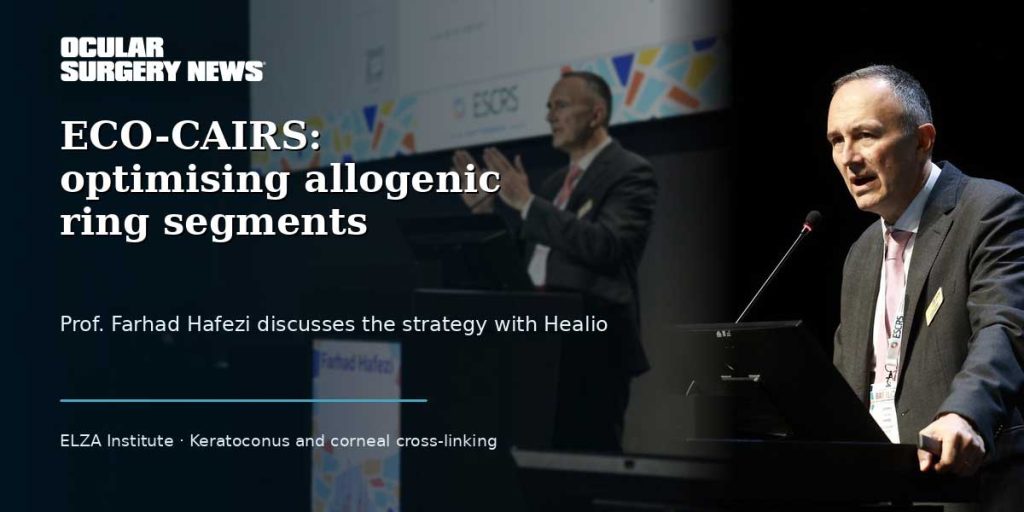
Prof. Farhad Hafezi, MD, PhD, FARVO, Medical Director of the ELZA Institute, has discussed ECO-CAIRS with Healio/Ocular Surgery News following his presentation at the ESCRS Winter Meeting in Athens.
The interview focused on ECO-CAIRS, or Extracorporeal Optimization of Corneal Allogenic Intrastromal Ring Segments. This strategy applies ultra-high-fluence corneal cross-linking to allogenic corneal ring segments before they are implanted into the patient’s cornea.
The aim is practical and biomechanical: to make donor corneal segments easier to handle, easier to implant, and more predictable once placed inside the corneal tunnel.
Why ECO-CAIRS was developed
CAIRS, or corneal allogenic intrastromal ring segments, are used in selected patients with keratoconus to regularize the cornea and improve visual quality. Unlike synthetic PMMA ring segments, CAIRS are made from donor corneal tissue. This gives them a more biologic interaction with the host cornea.
However, donor corneal tissue can be difficult to handle. In the Healio interview, Prof. Hafezi explained that Femto-CAIRS segments may be relatively soft or “floppy,” which can make insertion challenging, especially for surgeons who are still early in their learning curve.
ECO-CAIRS was developed to address this limitation. After the allogenic segments are cut with a femtosecond laser, they are cross-linked outside the eye before implantation. This is why the technique is described as extracorporeal: the optimization step takes place outside the patient’s body.
How ultra-high-fluence CXL changes the segment
In ECO-CAIRS, the donor corneal segment is treated with high-fluence corneal cross-linking, typically in the range of 30 J/cm² to 60 J/cm², before it is implanted. This stiffens the tissue and makes it easier to introduce into the intrastromal tunnel.
Because the cross-linking is performed outside the eye, the patient’s cornea, endothelium, crystalline lens, and retina are not exposed to this additional UV treatment. The goal is to modify the donor segment itself, not the surrounding ocular tissues.
Prof. Hafezi also explained that the treated segment remains flatter and more controlled during implantation. It then expands over time, which may contribute to the intended corneal flattening effect.
Why this matters for keratoconus surgery
Modern keratoconus treatment is no longer limited to stopping disease progression. In many patients, the goal is also visual rehabilitation: improving corneal shape, reducing irregular astigmatism, and helping the patient achieve better functional vision.
At ELZA, this rehabilitation strategy may include corneal cross-linking, ELZA-PACE customized CXL, wavefront-guided transPRK, Femto-CAIRS, or ECO-CAIRS, depending on the individual cornea. These approaches are not interchangeable; each has a different role within a staged, individualized treatment plan.
ECO-CAIRS is particularly relevant because it addresses the mechanical properties of the implanted tissue before surgery. By making the allogenic segment stiffer and easier to handle, the technique may improve surgical control and reduce some of the technical challenges associated with softer donor tissue.
A tissue-based alternative to synthetic ring segments
Allogenic ring segments are designed to provide a tissue-based alternative to synthetic intracorneal ring segments. As discussed in the Healio report, donor corneal tissue may be better tolerated than PMMA ring segments because it is biologic tissue rather than plastic.
ECO-CAIRS extends this concept by modifying the donor tissue before implantation. The aim is not simply to place a segment in the cornea, but to optimize that segment’s stiffness, volume behaviour, and handling characteristics before it enters the eye.
This reflects a broader direction in keratoconus surgery: moving from standard implants and uniform protocols toward customized, biomechanically informed treatment planning.
ELZA’s role in ECO-CAIRS development
The ELZA Institute has contributed to the development of several advanced approaches for keratoconus and corneal ectasia, including ELZA-PACE, Femto-CAIRS and ECO-CAIRS, and individualized cross-linking strategies for complex corneas.
In the Healio interview, Prof. Hafezi noted that the next step is to establish a nomogram based on segment volume and stiffness. The aim is to move toward a more customized effect for each cornea, rather than relying on a single standard segment behaviour.
This is consistent with ELZA’s broader approach to keratoconus care: stabilizing the disease where needed, improving corneal regularity where possible, and selecting the least invasive combination of procedures that is appropriate for each individual eye.
Read the Healio report
The full Healio/Ocular Surgery News article can be read here: ECO-CAIRS strategy offers optimization, ease of implantation for allogenic ring segments.

