
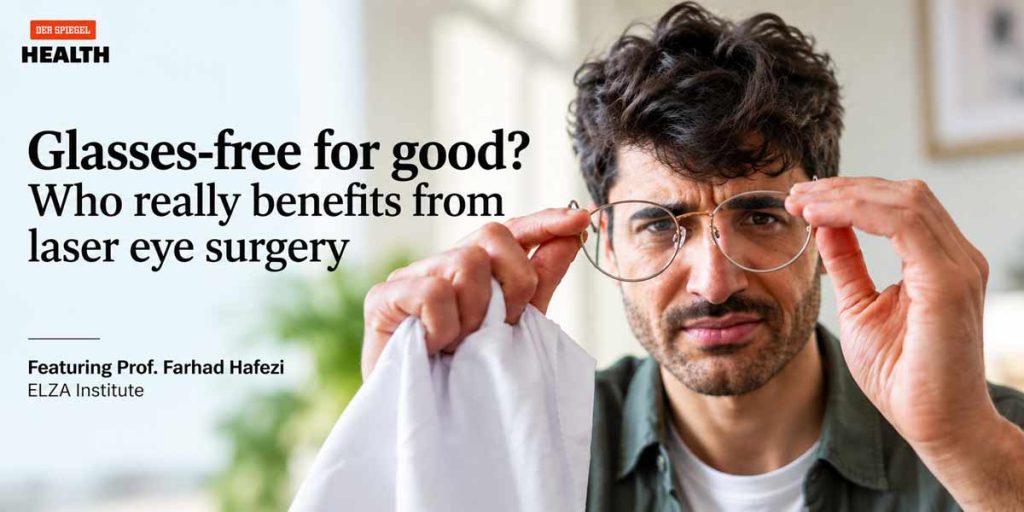
Laser eye surgery is one of the most common elective procedures in Europe, and one of the most heavily discounted. In Germany alone, more than 100,000 people a year have their vision corrected with LASIK. The cheapest offers now start at around 800 euros per eye. A July 2026 feature in SPIEGEL Health asked what that price pressure does to outcomes. Its conclusion, drawn from two corneal specialists, is worth repeating. Serious laser eye surgery complications are rare. However, the risk is largely settled before the laser is switched on.
One of those specialists was Prof. Farhad Hafezi, Medical Director of the ELZA Institute in Zurich. His clinic has become a destination for people whose refractive surgery went wrong elsewhere. What follows is the practical substance of that reporting, with the sources for each claim.
Key takeaways
- Long-term studies rate PRK and LASIK as very safe, and serious laser eye surgery complications are uncommon.
- The often-quoted 95 per cent satisfaction rate comes from a review of surgery performed between 1995 and 2003. It says little about any individual clinic today.
- Mild side effects, small irregularities and simply disappointing results are far more common than serious complications, and are recorded far less systematically.
- Most laser eye surgery complications trace back to the pre-operative work-up, the equipment and the time available, rather than to the laser itself.
How common are laser eye surgery complications?
A 2022 review cited by SPIEGEL Health rates both PRK, the oldest surface method, and LASIK as very safe, with complications described as rare. However, the studies behind such reviews mostly capture severe events: deep infections, corneal scarring, substantial loss of vision. Smaller irregularities, a suboptimal result or persistent dryness are recorded far less systematically. So the published safety record describes disasters better than it describes disappointments.
The 95 per cent satisfaction figure that appears in almost every clinic brochure deserves the same scepticism. It comes from a systematic review published in 2009. That review pooled 19 studies covering 2,198 patients, and found an overall satisfaction rate of 95.4 per cent. Surgeons performed those procedures between 1995 and 2003. Lasers, diagnostics and patient selection have all moved on since then. In other words, the number describes the field two decades ago, not the clinic in front of you.
Side effects, complications and results that simply disappoint
Hafezi sorts laser eye surgery complications and their milder relatives into three groups. The distinction matters, because patients tend to worry about the rarest one.
Side effects are expected consequences of the surgery. Because corneal nerves are cut or ablated in every laser procedure, the eye becomes worse at signalling that it is dry. As a result the body produces less tear fluid, the patient blinks less, and the eye gets drier still. Dry eye and glare sensitivity are among the most frequent early effects. In most cases they improve over the first days and weeks.
Complications are the rare events. Typical late complications include keratectasia, a progressive bulging of the cornea after too much tissue has been removed. Another is clouding of the natural lens after implantation of a phakic lens. Infections are rarer still, but can scar the cornea and, in the worst case, lead to a transplant. Ectasia behaves much like keratoconus. Surgeons usually stabilise it with corneal cross-linking (CXL), which stiffens the cornea using riboflavin drops and controlled ultraviolet light.
Suboptimal results are, by Hafezi’s account, much the most common problem, and the least discussed. “Most people settle for a standard result,” he told SPIEGEL Health, although the technology available today can do considerably better.
Where laser eye surgery complications actually come from
Neither specialist blames the technology. Hafezi points instead at the commercial structure around it: the price pressure created by budget chains, and the shortfalls in staffing, equipment and time that follow. “Because we operate in a cosmetic environment, there is a lack of regulation and quality criteria,” he told the magazine.
Much of the damage happens before surgery. Hafezi describes a patient whose pre-operative record listed −6 dioptres instead of +6, and who ended up at +12. Errors of that kind, he says, usually come from haste. The same applies to measurement itself. If the refraction is not checked with the pupil pharmacologically relaxed, hidden dioptres can be missed. A run-of-the-mill measurement then produces a run-of-the-mill result.
The consumer organisation Stiftung Warentest reached a similar conclusion in early 2024. It sent test patients to five large German laser chains, and described the counselling they received as often alarmingly poor.
Who is not a good candidate
Prof. Siegfried Priglinger, director of the eye clinic at LMU Munich, puts the treatable range at roughly −8 to +3 dioptres. The prescription should also have changed by less than 0.5 dioptres over the past one to two years. Judging stability takes repeated measurements, so it needs a history rather than a single visit. Several conditions rule surgery out or make it inadvisable, among them cataract, glaucoma, corneal disease and some rheumatic or severe autoimmune conditions. A cornea that is too thin is a further exclusion, because removing tissue reduces the mechanical reserve that resists the eye’s internal pressure.
Age matters too. Laser correction of distance vision does not prevent presbyopia, the age-related loss of near focus that usually begins around 45. Reading glasses therefore remain likely later, however well the surgery goes.
The three families of laser procedure
Surgeons group the methods into three. PRK removes the surface layer and reshapes the cornea directly. It takes away the least tissue and leaves the cornea biomechanically most stable, but healing is slower and more uncomfortable. LASIK creates a hinged flap about 160 µm thick, reshapes the tissue beneath it, then lays the flap back down. Recovery is quicker and less painful, although the flap no longer contributes to corneal strength. KLEx, which includes SMILE, uses a femtosecond laser to cut a small lens-shaped piece of tissue inside the cornea. The surgeon then withdraws it through an incision of one and a half to two millimetres. This cuts fewer nerves and preserves more corneal stability.
On both specialists’ account, method choice is not where most laser eye surgery complications are decided. No method is best for everyone, and they agree that the choice belongs to a properly informed examination rather than to a price list. Hafezi regards classic LASIK with a mechanical blade, still advertised as the budget option, as no longer state of the art. ELZA’s own laser vision correction service offers femto-LASIK, TransPRK and KLEx for that reason.
Does the price tell you anything?
Sometimes. Most German providers start a little above 1,000 euros per eye, and KLEx procedures generally exceed 2,000. Hafezi’s rule of thumb is blunt. “If an operation on your eye costs as much as a washing machine, then as a patient I should be asking myself how that can be.” He is careful not to equate cheap with bad, though. In a very average case, he notes, even a poorly trained surgeon can achieve a good outcome. The trouble starts as soon as the eye departs from the norm, because that is when experience, diagnostics and time have to make up the difference.
In Germany, statutory health insurers do not cover refractive laser surgery, since it does not count as medically necessary.
What this could mean for you
Very little about laser eye surgery complications is under a patient’s control once surgery begins. Almost everything is under their control while choosing where to have it.
- Judge a clinic by its work-up, not its offer. A thorough examination, performed unhurriedly and with the operating surgeon present, is the single best signal both specialists name.
- Prefer a surgeon who offers more than one technique, including phakic lens implants and lens surgery. Otherwise the recommended method risks being the one that clinic happens to perform.
- Treat haste, time pressure and dated equipment as warning signs.
- Expect a discussion of your prescription stability, your corneal thickness and your age, not just a quotation.
- Get a second opinion whenever the plan or the price feels unclear. Both specialists were explicit on that point.
Questions worth asking before you book
- Who will perform my surgery, and will that person also carry out my examination?
- Which methods do you offer, and why is this one right for my eyes?
- How thick is my cornea, and how much tissue will be removed?
- Was my refraction measured with the pupil relaxed, and were hidden dioptres checked for?
- How stable has my prescription been over the past two years?
- What happens, and at whose cost, if the result needs an enhancement?
If something has already gone wrong
Poor outcomes and laser eye surgery complications are not always final. Therapeutic refractive surgery can improve irregular corneas, treat ectasia and recover functional vision in many cases. It is, however, a far more demanding undertaking than the original procedure. ELZA sees such patients at its two Zurich-area clinics, including many referred from Germany. It also offers an online video consultation for people seeking a second opinion before travelling. A separate page describes what a first visit involves.
Frequently asked questions
How common are laser eye surgery complications?
Serious complications such as infection, scarring or significant vision loss are rare, and long-term reviews rate PRK and LASIK as very safe. Milder side effects like dryness and glare are common in the first weeks, and merely disappointing refractive results are more frequent than either.
What is corneal ectasia?
Ectasia is a progressive forward bulging of the cornea that can follow surgery if too little tissue is left behind. It resembles keratoconus, and cross-linking is the usual way to stabilise it.
Does a low price mean a bad result?
Not automatically. In a straightforward case a cheap procedure can go perfectly well. Savings tend to show up in staffing, equipment and time, so they matter most in eyes that deviate from the average.
Will dry eye after laser surgery be permanent?
Usually not. Dryness reflects cut corneal nerves and generally improves over the first days and weeks, though some patients need tear substitutes for longer.
Can a poor result be corrected?
Often, yes. Many laser eye surgery complications can be improved. Options range from a further laser treatment to therapeutic refractive surgery. The assessment needs a specialist centre familiar with complex cases.
References
- Silberg V. Fuer immer ohne Brille? Fuer wen sich Lasern wirklich lohnt. SPIEGEL Health, Ausgabe 28, 9 July 2026.
- Solomon KD, Fernandez de Castro LE, Sandoval HP, et al. LASIK world literature review: quality of life and patient satisfaction. Ophthalmology. 2009;116(4):691-701. doi:10.1016/j.ophtha.2008.12.037
- Stiftung Warentest. Beratung zum Augenlasern im Test, test 2/2024. Available at test.de

