
Keratoconus is usually caught late. By the time blurred vision sends someone to a clinic, the cornea – the clear dome at the front of the eye – has often already changed shape. What happens next depends on questions the field is still arguing about: how thin a cornea can safely be treated, whether a weakened cornea can be reshaped as well as stabilised, and how long any of it lasts. ELZA at ESCRS 2026 is in large part an attempt to answer them.
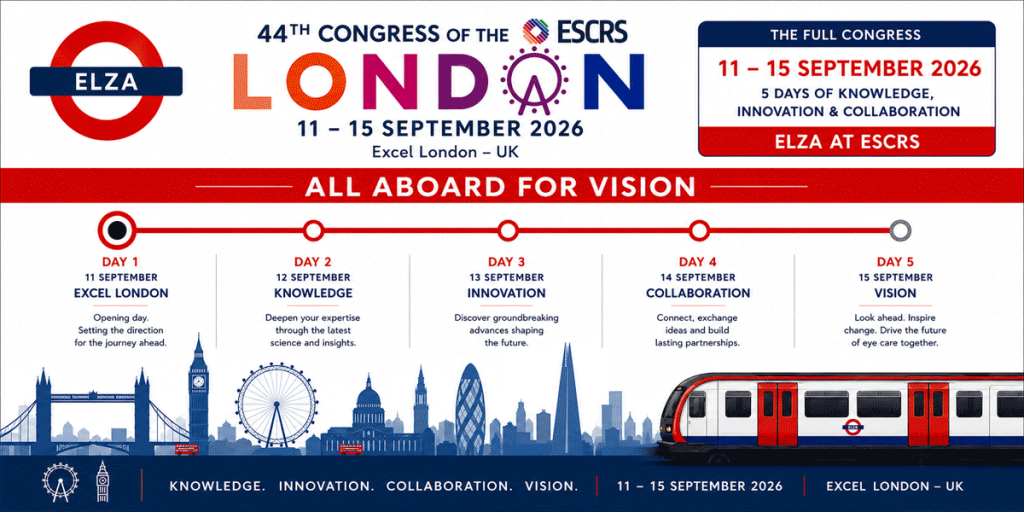
Those questions run through almost everything the ELZA Institute is taking to London. The 44th Congress of the European Society of Cataract and Refractive Surgeons runs from 11 to 15 September 2026 at ExCeL London, and ELZA at ESCRS 2026 amounts to seven podium presentations, nine invited lectures, six chaired sessions and six e-posters.
What ELZA at ESCRS 2026 covers
The largest single block falls on Sunday morning, when three consecutive papers from the group appear in the same free-paper session on advanced cross-linking. Cross-linking (CXL) uses riboflavin – vitamin B2 drops – and ultraviolet light to stiffen a weakened cornea and halt keratoconus. It has been standard care for two decades, which makes long-term data the obvious next question. Dr Michalina Furrer opens that session with ten-year outcomes of the original epithelium-off protocol. Two branded ELZA protocols also feature. ELZA-PACE is a customised, epithelium-on form of cross-linking that aims to reshape the cornea as well as stabilise it, recovering some of the vision keratoconus takes away. ECO-CAIRS stiffens donor tissue ring segments with ultra-high-fluence cross-linking before they are implanted, so that they hold their shape once inside the eye. Beyond the cornea, Prof. Kaweh Mansouri carries the glaucoma programme with a Glaucoma Day debate slot, a chaired session and an instructional course. Nikki Hafezi opens the ESCRS Research Workshop on how to tell a research idea worth pursuing from one that is not. The workshop, I have a great idea… now what?, is chaired by Prof. Farhad Hafezi and follows a clinical idea the whole way to a product: patents, ownership and collaboration agreements; prototype to CE-marked, FDA-cleared device; and who funds each stage and what they want back. It closes with an open Q&A. Prof. Hafezi also speaks at the inaugural ESCRS Global Affiliates Forum on Sunday 13 September at 17:00 in Victoria Room 7, on the research opportunities open to ESCRS affiliate societies.The ELZA programme in full
Add the whole ELZA programme to your calendar
All times are London local (BST). Calendar entries carry the same moment in time, so a phone still set to Swiss time will show them an hour later until it switches over.
Six e-posters run on demand throughout the congress, covering repeat cross-linking after a first treatment failed, biomechanical screening in Uzbek schoolchildren, imaging agreement after CXL, keratoconus prevalence in Russia from the K-MAP study, the distinct corneal shape of keratoconus in patients with Down syndrome, and glaucoma drainage device outcomes.
Following along
The full ESCRS congress programme is available here.

