
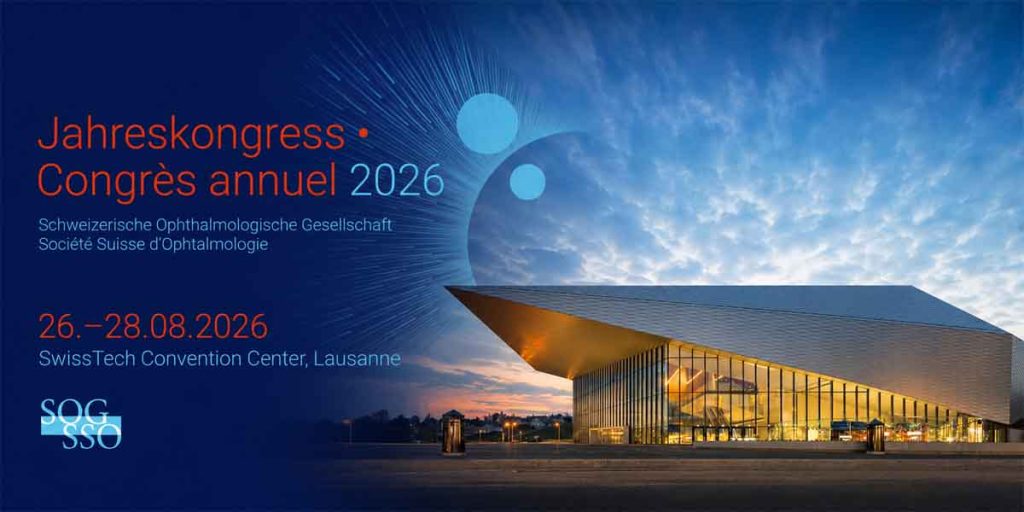
Two questions have shaped corneal practice over the past decade. When should a keratoconus be treated, and how do you identify the corneas at risk before sight is lost? Both were on the podium at the 119th annual congress of the Swiss Ophthalmological Society. The meeting ran from 26 to 28 August 2026 at the SwissTech Convention Center on the EPFL campus in Lausanne. ELZA at SOG 2026 meant two contributions to that programme, from Prof. Farhad Hafezi, MD, PhD, FARVO, Medical Director of the ELZA Institute, and Dr. Emilio A. Torres-Netto, MD, PhD, FEBO, FWCRS.
Redefining keratoconus, the second global consensus
On Thursday afternoon, Auditorium C hosted a plenary symposium convened under the banner of the European Society of Cataract and Refractive Surgeons, titled Redefining Keratoconus, The 2nd Global Consensus. Prof. Hafezi chaired it with Frank Blaser of Zurich. He also opened it, with the introductory talk Introduction to the 2nd Global Consensus and CXL for Progression.
The first global consensus statement gave the field a shared vocabulary for keratoconus – a disease in which the cornea, the clear front window of the eye, progressively thins and bulges into a cone, distorting vision. It mattered because definitions have consequences. What counts as progression determines who is treated, when, and on what evidence.
A decade on, the ground has moved. Corneal cross-linking (CXL) stiffens the cornea using riboflavin drops and ultraviolet light. It is now the standard way to halt progression, and its reach has extended to children, to thin corneas and to eyes once considered untreatable. The revision therefore has to account for a field in which stabilisation is routine and the harder questions are about timing and rehabilitation. The rest of the session followed that logic. Namrata Sharma of New Delhi spoke on keratoplasty approaches, and Mohamed Shafik Shaheen of Alexandria on elective refractive surgery in these patients.
Corneal biomechanics as a translational tool
The following morning, Dr. Torres-Netto spoke in the ARVO-SWISS Symposium 2026, New Diagnostic Tools in Ophthalmology. Carlo Rivolta of Basel and Hoai Viet Tran of Lausanne chaired the session. His talk was titled Corneal Biomechanics as a Translational Tool for Clinical Decision-Making.
The distinction it turns on is a simple one. Corneal topography measures shape, and shape is what clinicians have traditionally used to diagnose keratoconus. Biomechanics measures something different, namely how the tissue actually deforms under load. A cornea can weaken before it visibly changes shape. Biomechanical measurement therefore offers the prospect of catching the disease earlier, and of deciding more confidently which eyes need treatment and which can be watched.
That theme ran through the whole symposium. Alongside Dr. Torres-Netto, Ismail Moghul of London presented Eye2Gene, an artificial-intelligence tool for inherited retinal disease. Timothé Laforest of Geneva then spoke on adaptive optics for cellular-level retinal imaging. In each case the argument was the same: measure earlier, measure more precisely, and the clinical decision becomes easier.
ELZA at SOG 2026 and the meeting around it
The SOG congress is the Swiss profession’s annual fixture, and its scientific programme is assembled by the society’s Scientific Commission under Prof. Sandrine Zweifel. This year’s edition also carried the Goldmann Lecture, delivered by Prof. Kyoko Ohno-Matsui of Tokyo on pathologic myopia. In addition, it held a first plenary on women in ophthalmology and a joint symposium with the Ophthalmological Society of Taiwan. Full details are on the congress website.
Seen together, the two ELZA at SOG 2026 contributions point the same way. One asks how the profession should define and stage keratoconus; the other asks how it should measure the cornea in the first place. Prof. Hafezi was central to the clinical development of cross-linking, and Expertscape ranked him in 2024 as the world’s leading authority in the field. Dr. Torres-Netto’s research, meanwhile, sits at the junction of corneal biomechanics, cross-linking and refractive surgery. Between them, the two talks describe a discipline moving from stabilising disease towards measuring it well enough to intervene at the right moment.
ELZA treats keratoconus at its clinics in Dietikon and Zurich main station, including ELZA-PACE customised cross-linking and ELZA-sub400 for very thin corneas.

