

ELZA’s Chief Medical Officer, Prof. Farhad Hafezi, MD, PhD, FARVO, and its Chief Executive Officer, Nikki Hafezi, MAS IP ETHZ, are in China this week for a series of ophthalmology meetings, academic exchanges, and invited presentations focused on refractive surgery, keratoconus, and corneal cross-linking.
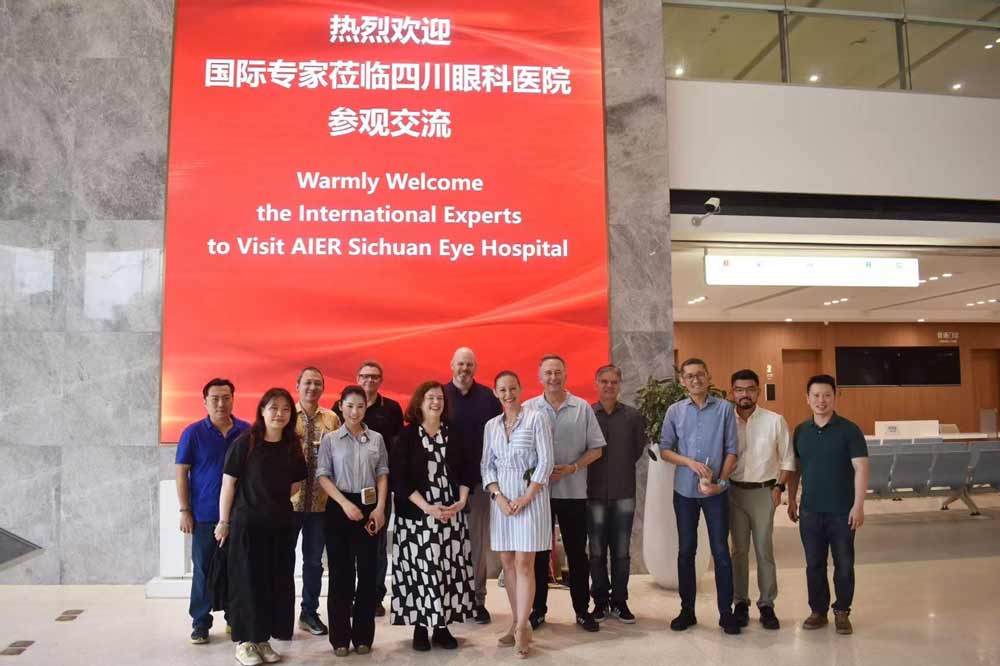
The visit began in Chengdu at the 5th International Refractive Surgery Symposium, hosted by AIER Eye Hospital Group on 23–24 May 2026. From there, the programme continued with professional exchanges at AIER centres in Wuhan and Changsha, before moving to Tianjin for Vision China 2026.
For ELZA, the visit reflects the increasingly international nature of corneal and refractive surgery. Keratoconus, ectasia prevention, and refractive surgery safety are not regional questions. They are global clinical challenges that require shared data, careful patient selection, and continued exchange between high-volume clinical networks and academic centres.
From standard CXL to customized cross-linking
At the International Refractive Surgery Symposium in Chengdu, Prof. Hafezi presented “Corneal CXL & Keratoconus: from one protocol to now customization.” The presentation traced the development of corneal cross-linking from the original Dresden protocol to newer, individualized approaches.
CXL was first introduced to halt the progression of keratoconus. Since then, the field has moved beyond a single standardized protocol. Contemporary CXL now includes accelerated epi-off protocols, epi-on approaches, oxygen-aware treatment concepts, and individualized strategies for thin corneas and irregular ectasia patterns.
This evolution is closely linked to ELZA’s clinical and scientific work. The ELZA-sub400 protocol was developed for progressive keratoconus in corneas thinner than 400 µm, using pachymetry-guided individualized UV fluence to improve safety in ultra-thin corneas. ELZA-PACE is a customized CXL approach designed to stabilize keratoconus while also improving corneal shape by using controlled treatment gradients.
Together, these approaches represent a broader shift in keratoconus care: from simply stopping progression to also asking how corneal shape, optics, and long-term visual quality can be improved.
Risk factors in refractive surgery
Nikki Hafezi also presented in Chengdu on “Risk Factors to Consider Prior to Refractive Surgery.” Her presentation focused on patient selection, preoperative screening, and risk stratification before procedures such as LASIK, PRK, KLEX, ICL implantation, and refractive lens exchange.
This topic is central to modern refractive surgery. Excellent outcomes depend not only on surgical technique, but also on identifying patients who may be at higher risk before surgery takes place. Important considerations include subclinical keratoconus, abnormal corneal biomechanics, residual stromal bed thickness, percentage tissue altered, pregnancy, thyroid dysfunction, and other systemic or hormonal factors.
The key message is simple: refractive surgery safety begins before the laser, lens, or surgical instrument is used. Careful screening helps determine whether a procedure is appropriate, whether an alternative treatment should be considered, or whether surgery should be deferred.
AIER exchanges in Wuhan and Changsha
Following the Chengdu symposium, the ELZA team’s programme included visits and professional exchanges with AIER centres in Wuhan and Changsha. These exchanges included discussion of refractive surgery, dry eye care models, and the organisation of high-volume ophthalmic services.
Such meetings are valuable because they allow clinicians and research teams to compare practical approaches to diagnosis, treatment pathways, follow-up, and patient education. For ELZA, they also provide an opportunity to share experience from Zurich in advanced CXL, keratoconus rehabilitation, and refractive surgery safety.
Vision China 2026 in Tianjin
The final part of the China programme takes place at Vision China 2026 in Tianjin. Prof. Hafezi is scheduled to speak again on customized CXL and keratoconus, and to present on PACK-CXL for infectious keratitis. PACK-CXL is a form of photoactivated chromophore for keratitis cross-linking that may be considered in selected cases of infectious keratitis, particularly when standard antimicrobial treatment is insufficient or when the cornea is at risk.
Nikki Hafezi is scheduled to present on refractive surgery risk factors and on K-MAP, a global keratoconus prevalence study in children and adolescents. K-MAP reflects a major unmet need in eye care: understanding how common keratoconus is in different populations, and how earlier detection might improve access to timely treatment.
International exchange with a practical purpose
International meetings are sometimes viewed as abstract academic events. In corneal and refractive surgery, however, they have direct clinical relevance. The questions discussed in Chengdu, Wuhan, Changsha, and Tianjin are the same questions that affect patients in Zurich: Who is suitable for refractive surgery? How can early keratoconus be detected? How should thin corneas be treated? Can cross-linking be customized? And how can sight-threatening infections be managed when standard treatment is not enough?
For ELZA, Nikki and Farhad Hafezi’s activities in China this week underline a consistent priority: translating research, international collaboration, and clinical experience into safer, more individualized eye care.
