Mark Hillen

Vitamin B2 tablets and sunshine. Hard lenses that hold the cone back. A cornea too thin to treat. Seven things patients are commonly told about keratoconus, checked against the Second Global Consensus, in which 128 corneal experts from six continents voted on what the evidence actually supports.
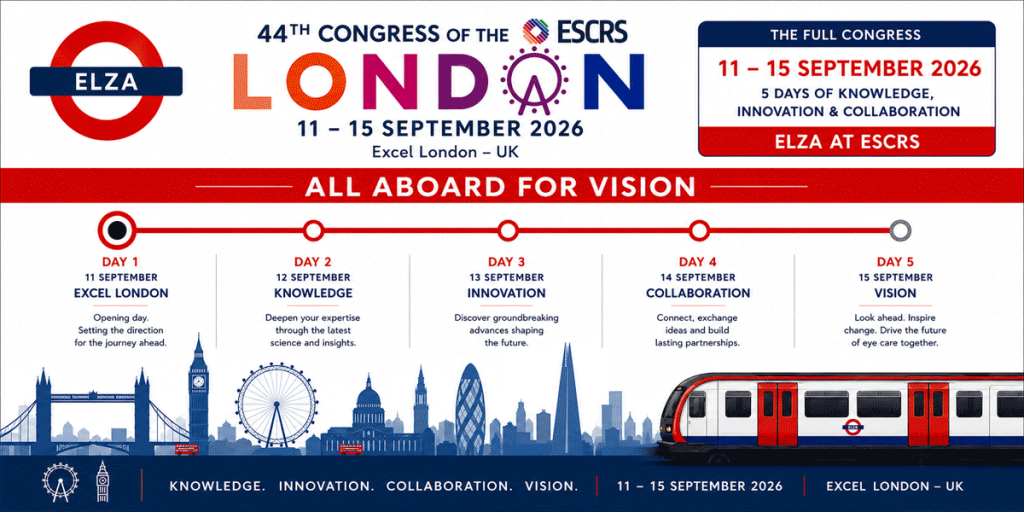
The ELZA Institute travels to the 44th ESCRS Congress at ExCeL London, 11 to 15 September 2026, with seven podium presentations, eight invited lectures, six chaired sessions and five e-posters. The programme spans ten-year cross-linking outcomes, customised ELZA-PACE, ECO-CAIRS ring segments and keratoconus screening.
Swapping the UV lamp for the sun and riboflavin drops for a vitamin B2 tablet is being promoted as a low-cost keratoconus treatment. A new ELZA study in the Journal of Refractive Surgery tested it in living eyes and found no corneal stiffening at all.
A new Die Ophthalmologie review explains ELZA-sub400 cross-linking, an individualised protocol that fits the UV dose to each cornea, making cross-linking possible in keratoconus corneas as thin as 214 µm.
ELZA researchers report 12-month outcomes for a second-generation sub400 cross-linking protocol that extends CXL to ultra-thin keratoconus and post-LASIK ectasia corneas below 400 micrometres, halting progression in 76% of eyes while shortening treatment to about 18 minutes.
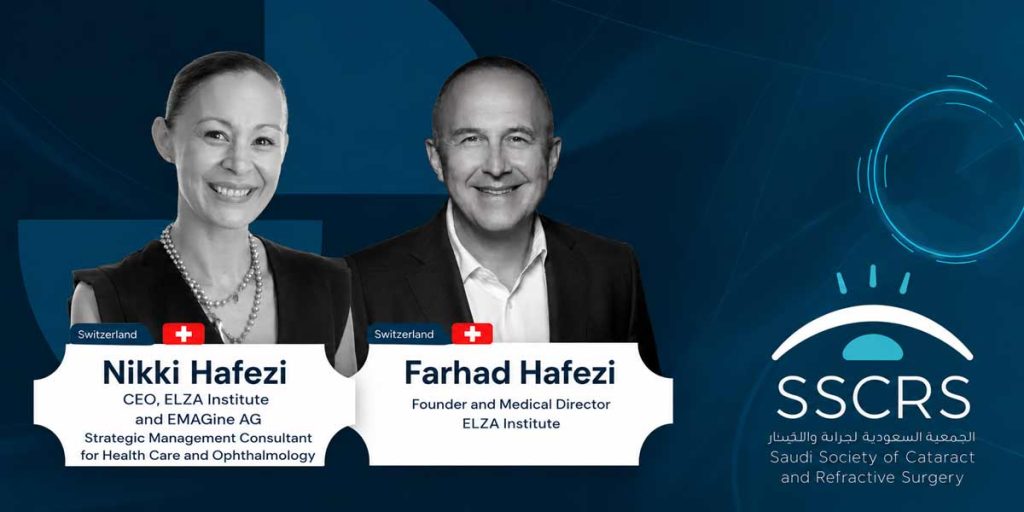
The ELZA Institute heads to Jeddah for the first SSCRS congress, 24–26 September 2026. Prof. Farhad Hafezi and Nikki Hafezi present four talks spanning personalised cross-linking, epi-on CXL, corneal biomechanics and ELZA-PACE.
Categories: | |
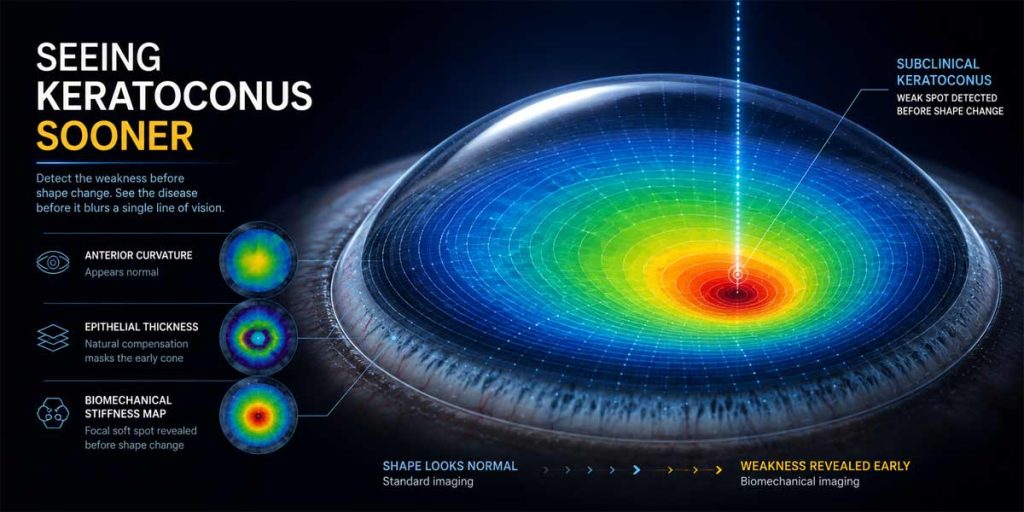
Corneal imaging in keratoconus – Scheimpflug tomography, OCT and epithelial mapping – now catches the disease years earlier. How modern scans work, from ELZA.
Categories:
For two decades, one of the most quietly transformative treatments in eye care has rested on a deceptively simple idea: if you can stiffen the cornea, you can stop a sight-threatening disease in its tracks…
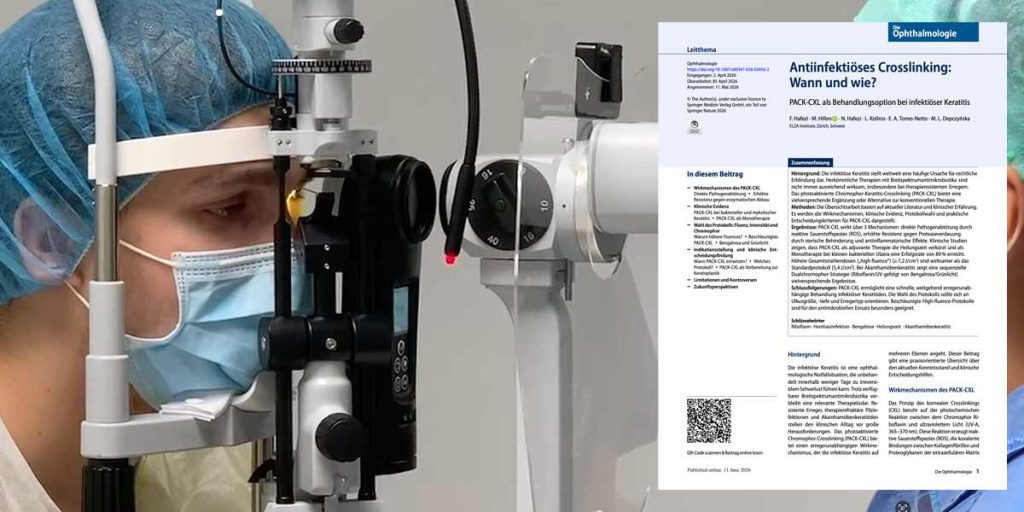
A new ELZA review in Die Ophthalmologie examines the mechanisms, clinical evidence, protocol selection, and indications for PACK-CXL in infectious keratitis.
Nikki and Farhad Hafezi represented ELZA at Vision China 2026, presenting work on keratoconus epidemiology, corneal cross-linking, K-MAP and international research collaboration.
.
.