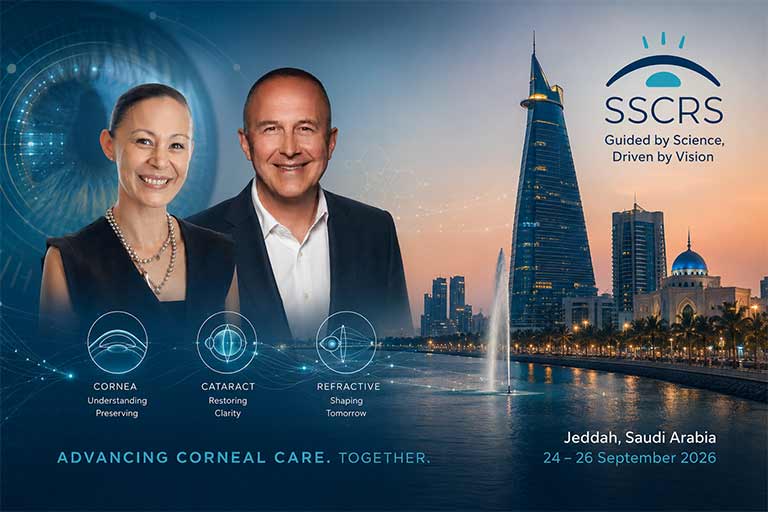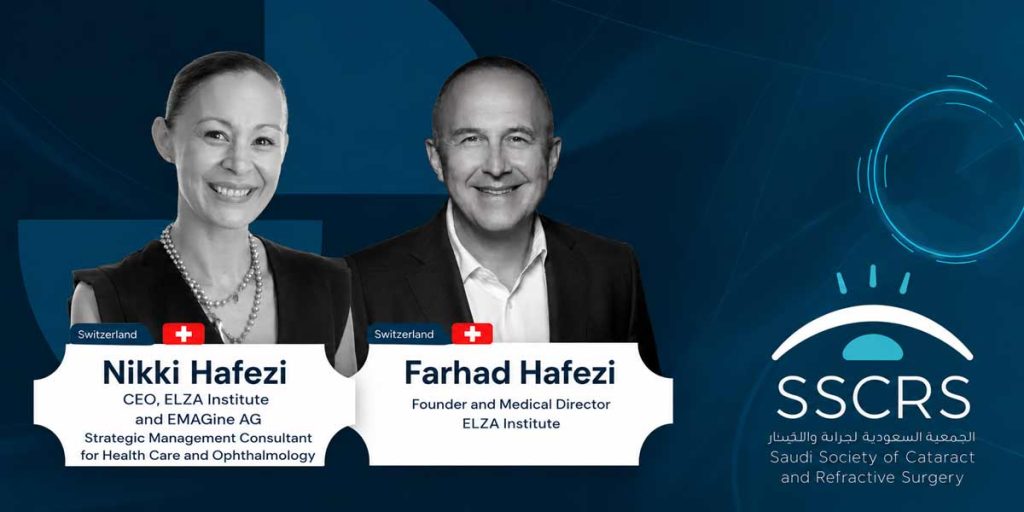
ELZA will be well represented at the first Annual International Conference of the Saudi Society of Cornea, Cataract, and Refractive Surgery (SSCRS), held in Jeddah, Saudi Arabia, from 24 to 26 September 2026. Prof. Farhad Hafezi, MD, PhD, FARVO, Medical Director of the ELZA Institute, and Nikki Hafezi, MAS IP ETHZ, Chief Executive Officer of ELZA AG, will both take part in the scientific programme, contributing four podium presentations between them alongside panel discussions in the Main Hall.
An inaugural congress is a statement of intent, and this one is unambiguous. Convened under the theme Guided by Science, Driven by Vision, the meeting sets out to bring together leading national and international specialists across cornea, cataract and refractive surgery, and to pair scientific lectures and panel discussions with hands-on workshops. For a first edition, the ambition is notably broad: not a regional update, but a meeting positioned within the wider international conversation about where corneal care is heading.
That framing sits comfortably with ELZA’s own work. The region has a particular stake in the corneal ectatic diseases. Keratoconus is more prevalent across the Middle East than in many other parts of the world, and it tends to present earlier and progress more aggressively. The clinical questions that follow — how to detect the keratoconus before it damages vision, how to stabilise thin and advanced keratoconus corneas, and how to rehabilitate sight once progression has been halted — are precisely the questions ELZA has spent years working on.
The ELZA programme at SSCRS 2026
The Institute’s contributions trace an arc that runs through the whole meeting: from the evolution of cross-linking as a discipline, to its refinement as a refractive tool, to the biomechanical thinking that underpins earlier and better diagnosis.
Thursday, 24 September — Main Hall
Prof. Hafezi opens with the keynote lecture, From One Protocol to Personalized CXL: 23 Years of Transformation (11:45), moderated by Dr. Bader AlQahtani. It is a fitting frame for the congress: the story of how corneal cross-linking has moved from a single standardised protocol toward treatment tailored to the individual cornea — a shift in which ELZA’s research has been central throughout.
Friday, 25 September — Main Hall
In the session Refractive Surgery Challenges in Our Everyday Practice, Prof. Hafezi presents ELZA epi-On CXL: Establishing a New Clinical Benchmark (from 10:50), setting out the case for epithelium-on cross-linking as a reliable, repeatable standard rather than a compromise.
Later, in Advances and Technology in Refractive Surgery, Nikki Hafezi speaks on Corneal Biomechanics and KC: Early Indicators (from 13:10) — turning to the measurable, mechanical signs that allow keratoconus to be caught earlier, before vision is lost. Prof. Hafezi follows with ELZA-PACE: Refractive Remodelling of the Ectatic Cornea (from 13:25), the approach that reframes cross-linking not merely as a way to arrest progression but as a means of controlled corneal reshaping to improve vision. Both also join the panels for these sessions.
The thinking behind the work
Prof. Hafezi was instrumental in the clinical development and international establishment of corneal cross-linking, and was recognised in the 2024 Expertscape rankings as the world’s foremost authority in the field. His work has extended cross-linking well beyond its original indication — to children, to post-LASIK ectasia, and, through PACK-CXL, to the treatment of corneal infection. The protocols he brings to Jeddah — from epi-on CXL and ELZA-sub400 for very thin corneas to ELZA-PACE — speak directly to the challenges the SSCRS programme sets out to address.
Nikki Hafezi’s contribution reflects the other half of that story. As CEO of ELZA AG and a specialist in intellectual property, her work bridges clinical innovation and the systems required to translate it into practice, including the application of biomechanical measurement and artificial intelligence to the earlier detection of keratoconus. In a region where earlier, more reliable detection could change outcomes at scale, that intersection of technology, access and clinical need is a timely one.
What both bring to Jeddah is less a single technique than a way of thinking about the cornea: as a dynamic structure that can be measured, modelled and modified with increasing precision, and as a field moving from stabilisation alone toward treatments that are both stabilising and rehabilitative. That is the direction of travel the SSCRS programme appears designed to explore, and it is one ELZA has helped to define.
We look forward to the exchange of ideas with colleagues from across the Kingdom and the wider region, and to a first edition that we expect will become a fixture in the international calendar.