
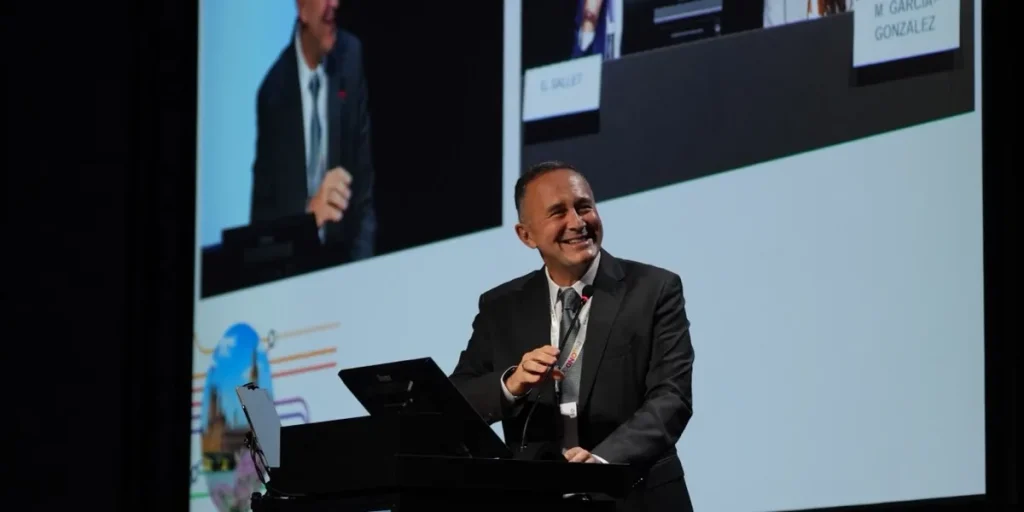
For two decades, corneal cross-linking has made a modest promise. It stops keratoconus getting worse. However, it does not undo the blurred, distorted vision the disease has already caused. At the 44th Congress of the ESCRS in London, from 11 to 15 September 2026, that ceiling was the recurring theme. ELZA’s ESCRS 2026 highlights came from more than a dozen presentations. They spanned cross-linking, corneal ring segments, glaucoma surgery and the business of turning a clinical idea into a product.
Reshaping the cornea without removing tissue
The boldest claim came from Prof. Farhad Hafezi. He presented ELZA-PACE, an epithelial map-guided protocol. Its aim is to regularise the cornea, not merely stabilise it. Conventional methods for improving vision in keratoconus either remove tissue with an excimer laser or add it with ring segments. ELZA-PACE does neither.
Instead, it combines three technologies:
- an epithelial map from a tomographer
- an excimer laser, used only to open a small epi-off window over the cone
- cross-linking (CXL), which stiffens the cornea using riboflavin (vitamin B2 drops) and ultraviolet light
Roughly 90 per cent of the cornea is treated epi-on, leaving the epithelium intact. A window of about 2.5 by 3.5 mm is treated epi-off. Four gradients then concentrate the effect over the cone. These act on UV transmission, oxygen, riboflavin concentration and delivered energy. As a result, the cone flattens while the cornea steepens above it. That coupling is what regularises the surface.
Hafezi showed one eye with 15 D of regularisation on the difference map. Corrected vision in that eye improved from 0.4 to 20/20 with glasses. Across the cohort, results were broader. Roughly 90 eyes reached one year, 35 reached two years and seven reached three. In addition, 40 per cent dropped at least one stage on the ABCD grading system. Symmetry and regularity improved in 94 per cent of eyes.
Thinnest pachymetry fell by 17 µm. Hafezi attributed this to compaction of collagen fibres rather than thinning. He noted it sits close to the 15 µm reported in long-term Dresden protocol papers. Despite fluences reaching 14 J/cm², he reported no clinically relevant haze at one year.
Two caveats were stated plainly. First, the analysis is not yet complete, and predictability remains the open problem. Some 70-year-olds improve dramatically, whereas some 19-year-olds improve only slightly. Second, the protocol depends on penetration enhancer drops. These have awaited a CE mark for more than two years, so other surgeons cannot yet adopt it.
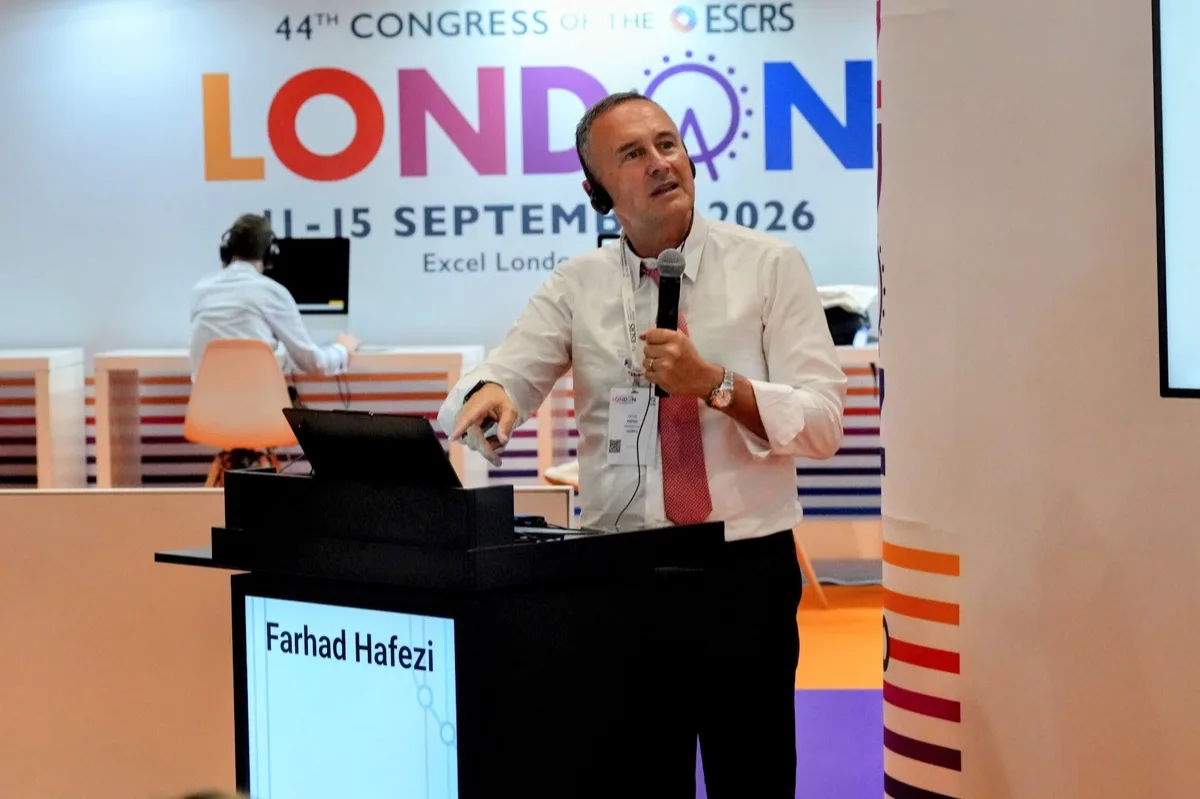
Prof. Farhad Hafezi at the presented poster session in London.
ECO-CAIRS and the shrinking case for corneal transplants
Dr. Emilio Torres-Netto presented ECO-CAIRS. His session asked whether penetrating keratoplasty for keratoconus could be obsolete by 2040. CAIRS replaces the rigid PMMA ring segments used since the 1990s with donor corneal tissue. Because the tissue is human, it avoids the melting, extrusion and neovascularisation that plastic implants can cause. However, donor tissue is soft and swollen, and therefore awkward to insert.
ELZA’s answer is to cross-link the segment outside the eye. There, the usual safety limits do not apply. An ex vivo study found stiffness rose up to 30 J/cm², then plateaued. Consequently, 30 J/cm² became the working dose.
Torres-Netto also showed OCT elastography data. It suggests CAIRS and PMMA segments work by different mechanisms. The relaxation zone seen inside a PMMA ring arc does not appear with CAIRS. That may explain why the two need different nomograms. He closed with a patient whose PMMA ring had been removed abroad after trauma. The removal left a scar exactly where a new segment had to go. He argued the case would not have been feasible with a rigid implant. Vision improved from 0.4 to 0.8.
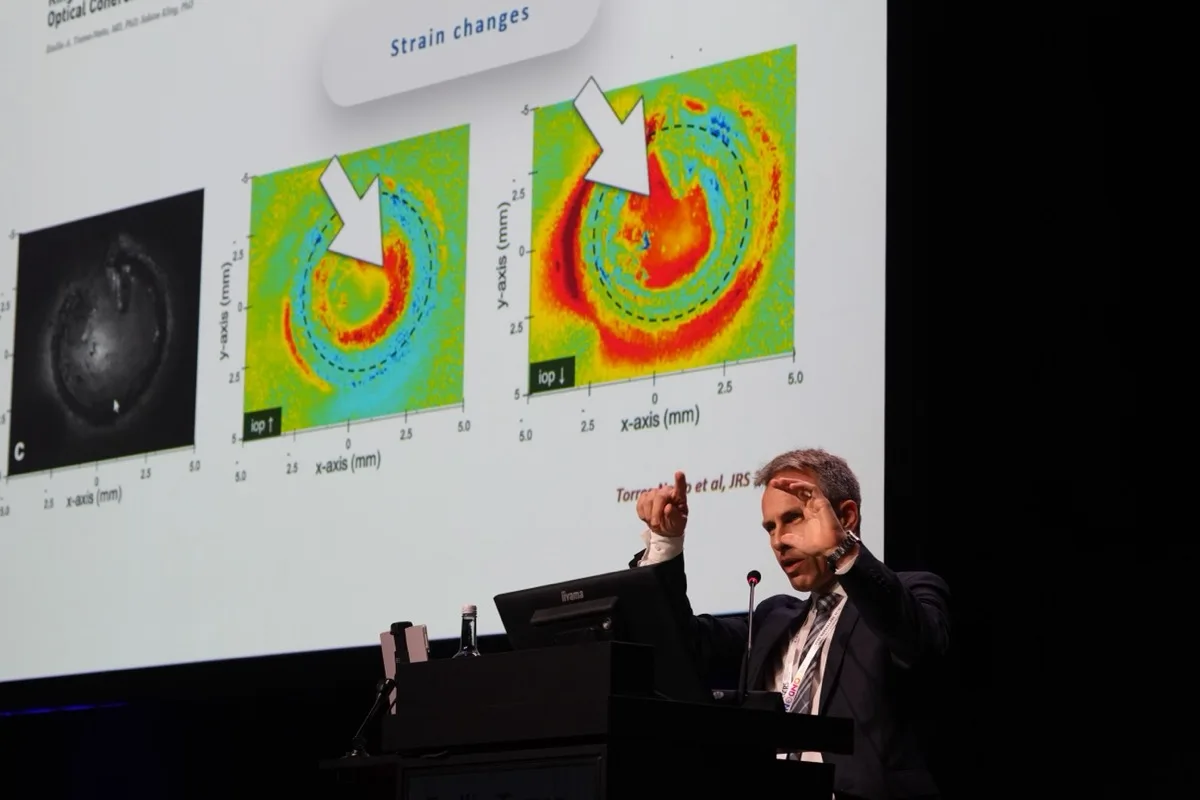
Dr. Emilio Torres-Netto presenting ECO-CAIRS.
What cross-linking looks like after ten years
Michalina Furrer presented the longest follow-up of the week. In total, 418 eyes were treated with the standard epi-off Dresden protocol in Zurich between 2004 and 2010. Of those, 38 had complete tomographic data at a mean of almost 11 years.
Maximum keratometry had fallen by 1.3 D. Corrected distance visual acuity had improved by 0.15 logMAR, or about a line and a half. Thinnest pachymetry was statistically unchanged. The long-term stabilisation rate was 90 per cent. Moreover, the analysed eyes showed no infectious complications and no limbal stem cell insufficiency.
She was candid about the limitations. The study is retrospective and single-region. It also draws on the earliest implementation phase of cross-linking, and it carries a high dropout rate. Nevertheless, the clinical message is clear. The original protocol does not merely halt keratoconus, because the flattening effect is still measurable a decade later.
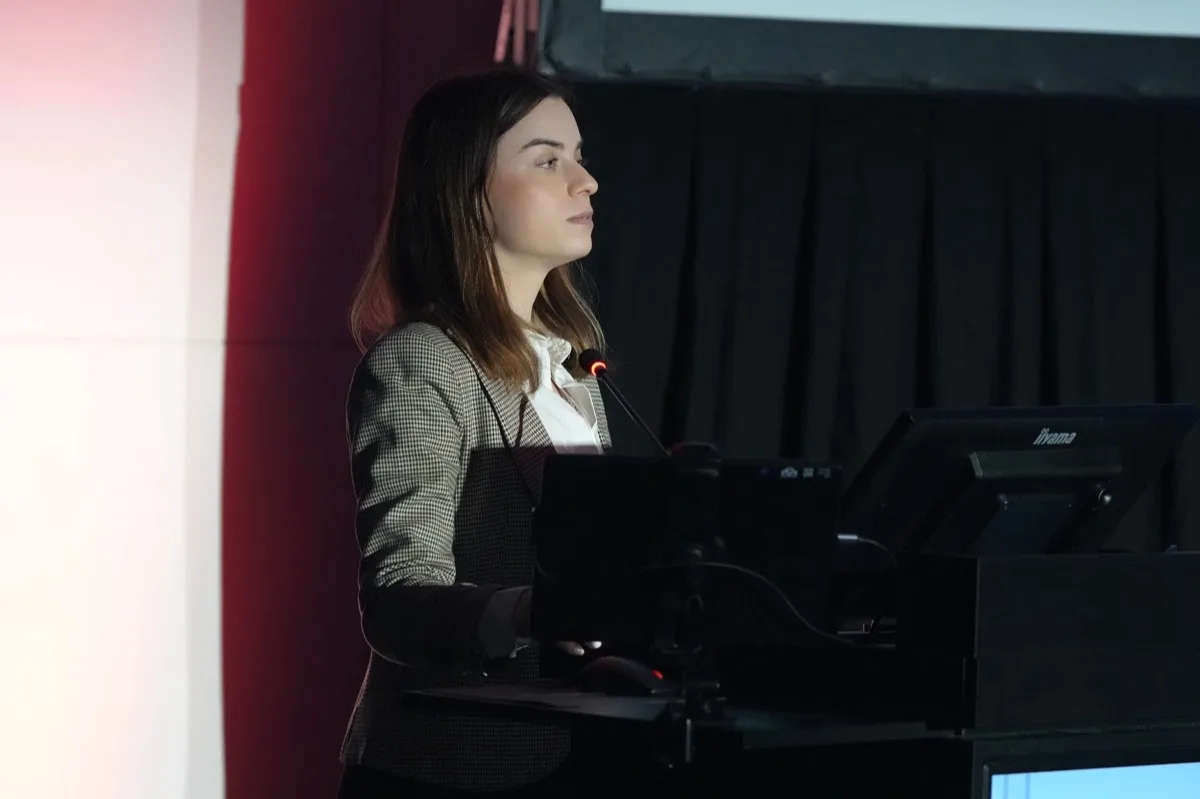
Michalina Furrer presenting the ten-year cross-linking outcomes.
A safety lesson drawn from other clinics
Not every ELZA presentation was about what works. Léonard Kollros reported 15 eyes from 11 patients. All were referred to ELZA with central toxic keratopathy after cross-linking performed elsewhere. It is the largest such series after standalone CXL. Ten eyes had a dense central stromal scar and five had a dense central haze. Four had corrected vision of 20/200 or worse.
Because the patients self-referred, and most original records were unavailable, Kollros was explicit that the series cannot establish an incidence. The mechanisms he proposed are practical ones. Riboflavin formulations can thin the stroma during treatment, leaving the delivered fluence too high for the remaining thickness. Alternatively, a UV source may be uncalibrated or ageing. The working distance may be wrong. Finally, the riboflavin may be locally compounded and lack a CE mark.
His recommendations follow directly. Calibrate and maintain the UV device. Verify the working distance. Measure pachymetry throughout the procedure. Above all, use CE-marked riboflavin.
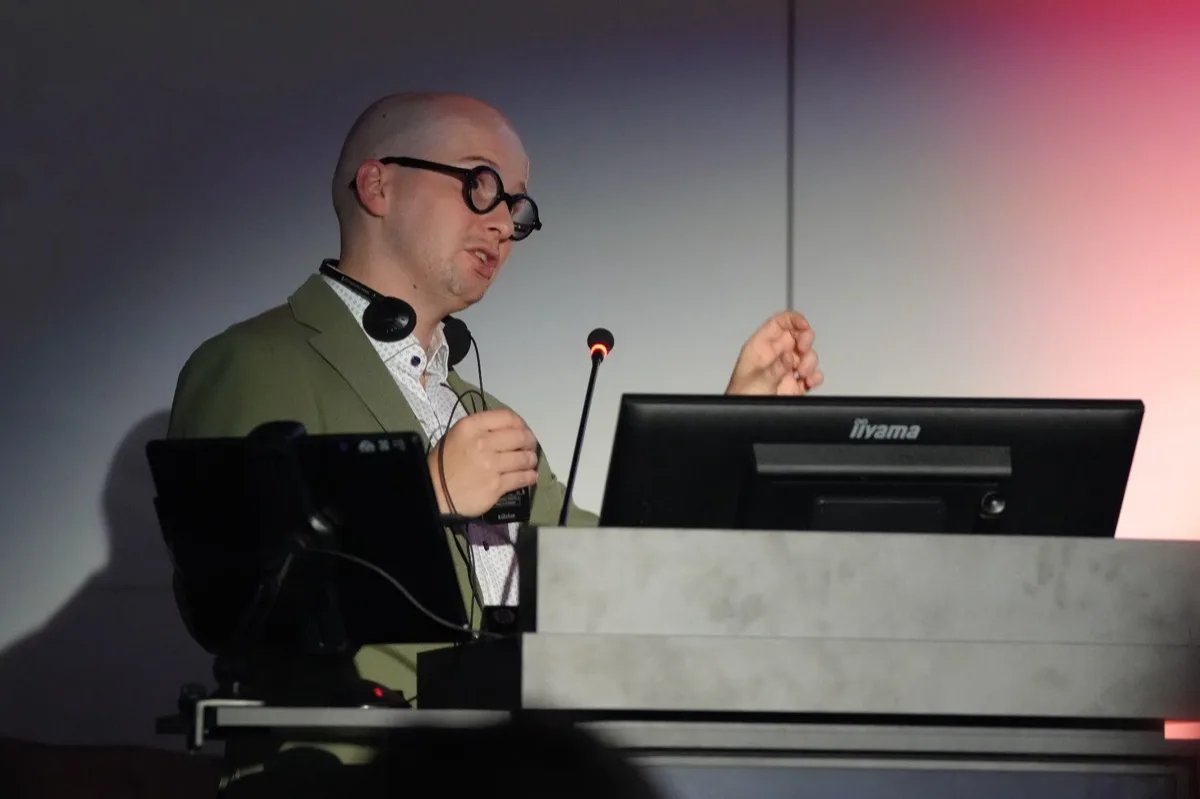
Léonard Kollros presenting in the free paper session.
When the answer is optical, not surgical
Furrer also presented work led by Kollros on mini-scleral contact lenses. These vault the cornea entirely, so a tear reservoir sits against the irregular surface. The study covered 22 eyes of 12 patients with stable keratoconus.
The lenses reduced vertical coma from -1.23 to -0.03 µm. High-contrast acuity improved by roughly 2.7 lines. Vision-related quality of life, measured with the NEI VFQ-25 questionnaire, rose from 62 to 84. Notably, the link between aberration and acuity was strongest at low contrast. Those are the conditions patients find hardest in daily life.
ESCRS 2026 highlights beyond the cornea
Dr. Lamis Baydoun opened the same symposium as Torres-Netto. Her subject was Bowman layer transplantation. She argued from the precedent of DMEK, which has largely displaced penetrating keratoplasty for Fuchs endothelial dystrophy since 2006. Keratoconus, she suggested, may follow a similar path away from full-thickness grafts.
Prof. Kaweh Mansouri spoke instead on glaucoma. He covered the intraoperative complications of deep sclerectomy and how to manage them. In addition, he presented on combined deep sclerectomy and cataract surgery.
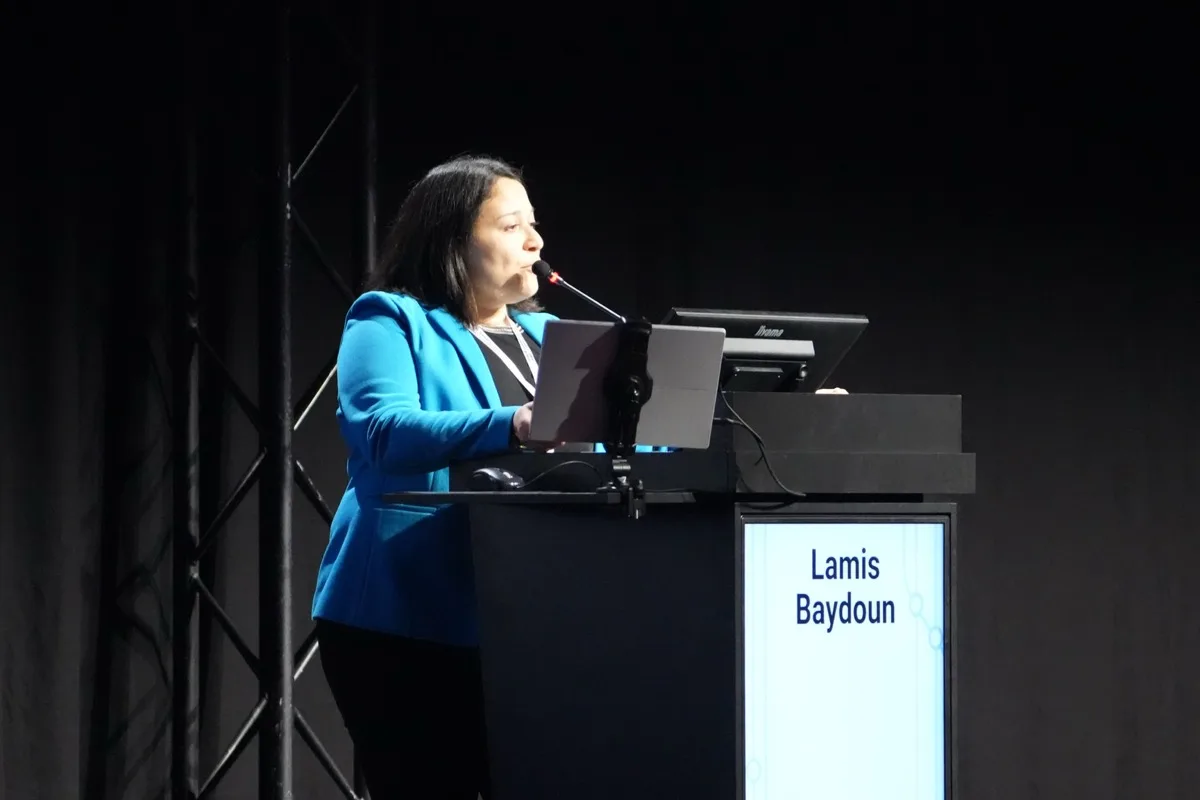
Dr. Lamis Baydoun on Bowman layer transplantation.
Turning a clinical idea into a product
Nikki Hafezi took the programme outside the clinic. She has worked as a strategic management consultant in ophthalmology for twenty years. Her question was one most clinicians eventually face. Is my idea really worth pursuing?
Her answer leaned on unglamorous examples, among them Gatorade and the Ziploc bag. The most durable products, she argued, tend to be simple solutions to common problems. Accordingly, the talk covered how to identify a genuine unmet need. It also addressed validating an idea before investing in it, and the choice between publishing and patenting.
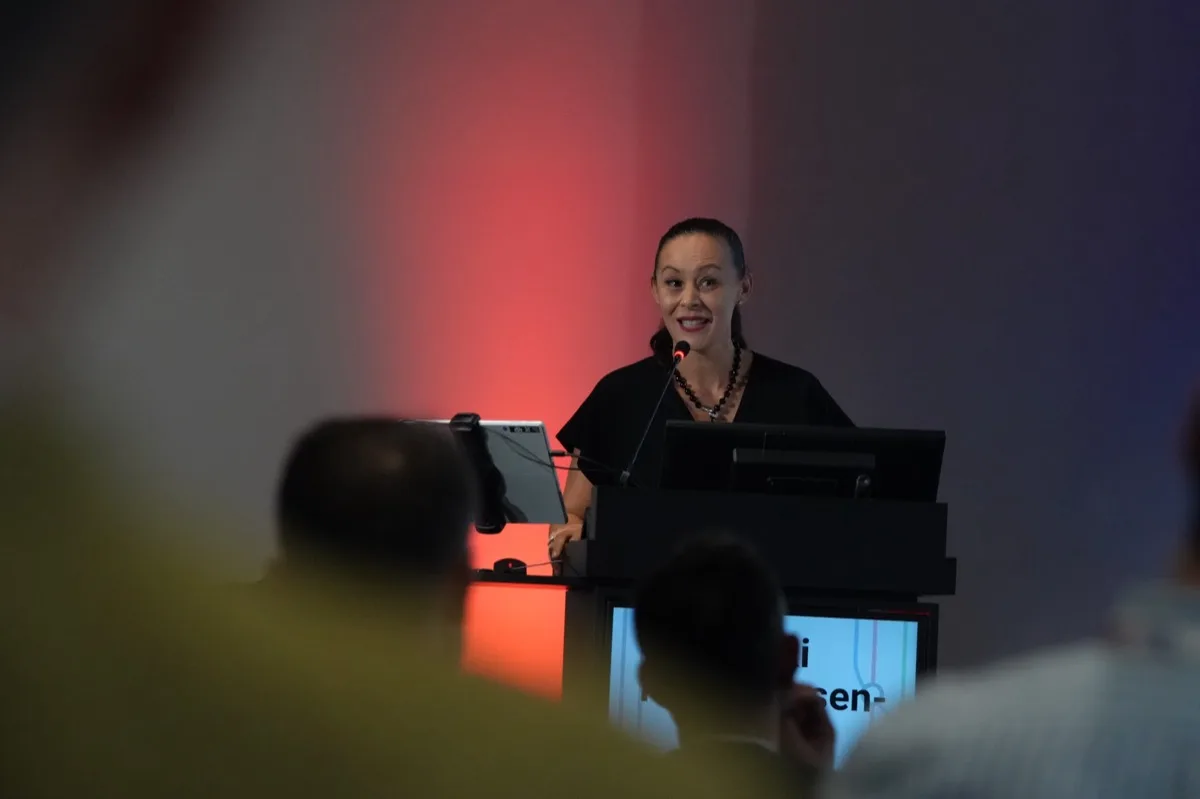
Nikki Hafezi on validating a clinical idea.
A consistent direction of travel
Taken together, the ESCRS 2026 highlights pointed one way. ELZA’s programme treated keratoconus as a condition that can be regularised and optically rehabilitated, rather than simply arrested. ELZA-PACE and ECO-CAIRS approach that goal from opposite directions. One remodels the tissue already present; the other adds reinforced donor tissue. Meanwhile, the ten-year Dresden data supply the baseline against which both will be judged. The central toxic keratopathy series is a useful corrective, because the safety of the technique still rests on calibration and dosimetry.
Cross-linking, ELZA-PACE and ECO-CAIRS are performed at the ELZA Institute. You can read more about the team on the Our Doctors page. Alternatively, see the keratoconus and corneal surgery pages for the conditions themselves.

Prof. Kaweh Mansouri during the glaucoma programme.
Day-by-day coverage is in our reports from Friday, Saturday, Sunday, Monday and the closing day. The congress preview lists the full ELZA programme.
References
- 44th Congress of the ESCRS, London, 11 to 15 September 2026 – European Society of Cataract and Refractive Surgeons
- Keratoconus patient information from the American Academy of Ophthalmology
